Oil-Free Air Compressors for Industrial Production
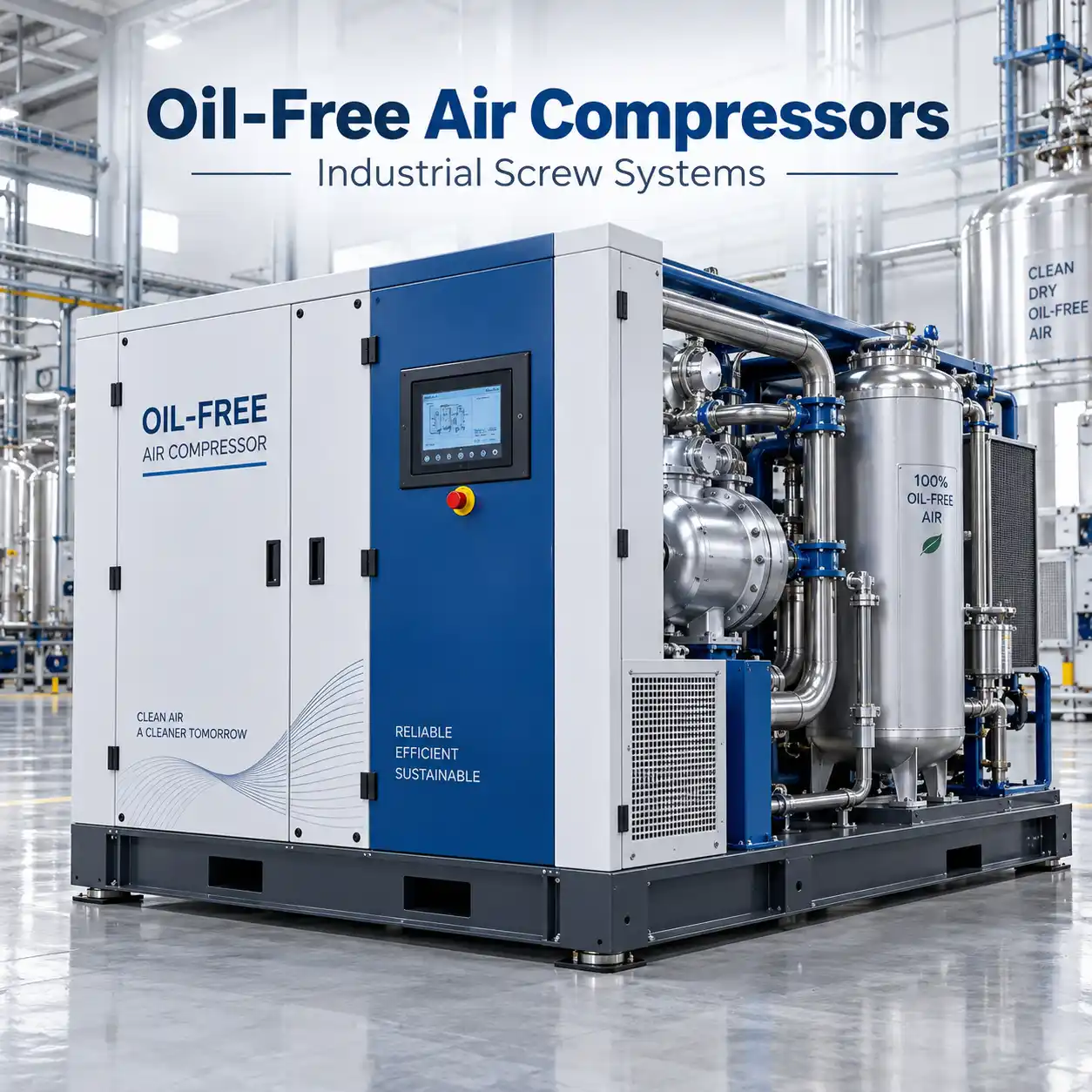
When compressed air comes into contact with a product, packaging material, or sensitive production equipment, lubricant carryover is an avoidable risk. AIRNOVEX oil-free air compressors provide industrial compressed air without injecting oil into the compression chamber.
Our oil-free screw compressor solutions are intended for facilities requiring dependable compressed air and tighter control over air quality, including food and beverage plants, pharmaceutical manufacturing, electronics, automotive production, and other industrial applications.
Available configurations include fixed-speed, variable-speed, and two-stage compression systems. Air delivery, working pressure, cooling arrangements, and electrical specifications can be reviewed according to individual project requirements. AIRNOVEX supports industrial end users, engineering contractors, distributors, and OEM customers across the United States, Europe, and international markets.
Benefits of AIRNOVEX Oil-Free Air Compressors
An oil-free screw air compressor removes injected lubricant from the compression process. For quality-sensitive manufacturing, this eliminates an important source of potential oil contamination while allowing the system to be configured around the plant's actual air demand.
No Oil Injection During Compression
The compression chamber operates without injected lubricating oil, reducing the risk of compressor lubricant entering the process-air supply.
Better Control of Air Quality
Oil-free compression provides a practical foundation for compressed air systems designed around specific particulate, moisture, and total-oil limits.
Continuous Industrial Operation
Rotary screw technology provides steady airflow for production equipment operating over extended working shifts, subject to correct sizing and maintenance.
Energy Management Options
Appropriate airend design, two-stage compression, and optional VSD/VFD controls help manage power consumption across different operating conditions.
Reduced Oil-Related Treatment Needs
Eliminating oil injection reduces the need to remove compressor lubricant carryover. Suitable treatment for ambient contaminants remains necessary.
Flexible Equipment Configuration
Compressor capacity, pressure, cooling, voltage, control options, and downstream air treatment can be reviewed together for the intended installation.
How Oil-Free Screw Air Compressors Work
An oil free rotary screw compressor uses rotating screw profiles to increase air pressure. As incoming air moves through the airend, the available volume between the rotors and housing progressively decreases.
Unlike an oil-injected screw compressor, an oil-free design does not introduce lubricant into the compression chamber. In a typical dry-running arrangement, external timing gears maintain rotor synchronization while lubricated bearings and gears remain separated from the process-air path.
Air Intake
Ambient air enters through an inlet filter before reaching the screw airend. The inlet system helps prevent airborne particles from entering the compression chamber.
Screw Compression
Precision-engineered screw elements compress the incoming air without oil injection. Rotor geometry and internal clearances influence airflow, operating temperature, and efficiency.
Cooling and Moisture Separation
Compressed air passes through the applicable cooling components. An aftercooler and moisture separator reduce discharge temperature and remove condensed water.
System Control
The compressor controller monitors operating parameters, including pressure and temperature. Variable-speed configurations also adjust motor speed within their designed operating range.
Two-Stage Compression and Intercooling
A two-stage screw compressor divides the pressure increase between separate compression stages. Air is partially compressed in the first stage, cooled through an intercooler, and then delivered to the second stage.
Lowering the intermediate air temperature can reduce compression work when the system is properly designed for the required pressure ratio. Actual efficiency should be evaluated using model-specific performance data rather than motor power alone.
Oil-Free Compressed Air and ISO 8573-1
Oil-free compression reduces lubricant-related contamination risk, but it does not automatically guarantee contaminant-free air at the point of use.
Incoming atmospheric air may contain particles, moisture, hydrocarbons, and other contaminants. The quality of delivered compressed air therefore depends on the complete system, including intake conditions, compression equipment, dryers, filtration, piping, and maintenance.
ISO 8573-1 provides a recognized classification system for three separate compressed air contamination categories:
- Solid particles
- Water
- Total oil, including liquid, aerosol, and vapor
About ISO Class 0: Class 0 requires an agreed contaminant limit more stringent than the corresponding Class 1 requirement. It does not automatically mean absolute freedom from all contaminants. The relevant contaminant category, test conditions, and supporting documentation should be established before ordering.
Typical Clean Compressed Air System Components
| Component | Function |
|---|---|
| Oil-Free Screw Compressor | Compresses air without introducing lubricant into the compression chamber. |
| Aftercooler | Reduces the temperature of compressed air after compression. |
| Moisture Separator | Removes condensed water from the compressed air stream. |
| Air Receiver Tank | Provides compressed air storage and helps manage short-term demand changes. |
| Refrigerated Air Dryer | Provides moisture control for applications with moderate pressure dew point requirements. |
| Desiccant Air Dryer | Provides lower pressure dew points for applications requiring drier compressed air. |
| Downstream Filtration | Addresses specified particle, aerosol, or vapor limits where required. |
For pharmaceutical, food-contact, laboratory, or medical applications, the facility's specific air quality requirements and applicable standards should guide the final system design.
Applications of Oil-Free Air Compressors
Industrial oil-free compressors are commonly selected where unwanted lubricant residue could affect product quality, equipment performance, or process consistency. The required compressed air purity varies by application.
Food & Beverage
Compressed air is used in packaging, filling, bottling, pneumatic conveying, and production automation. Where air contacts food, ingredients, or packaging surfaces, the system should be designed around the facility's specified contamination limits.
Pharmaceutical Manufacturing
Applications include process equipment, material handling, instrumentation, and packaging machinery. Direct product-contact air may require additional treatment, documented testing, and facility-specific validation.
Electronics Manufacturing
Precision assembly, automated handling, cleaning processes, and sensitive manufacturing equipment can benefit from reducing lubricant-related contamination in the compressed air supply.
Medical & Laboratory Equipment
Selected instruments and healthcare-related processes use carefully controlled compressed air. Medical breathing-air systems require separate engineering, suitable treatment equipment, monitoring, and compliance with applicable standards.
Automotive Production
Automotive facilities use compressed air for robotic assembly, pneumatic tools, component handling, and selected finishing operations where unwanted oil residue may affect production quality.
Textile Industry
Air-jet looms, spinning machinery, and pneumatic transport systems require consistent airflow. Oil-free compression helps reduce lubricant contamination where air contacts fibers or finished materials.
Chemical Processing
Applications may include plant instrumentation, automated valves, and selected process operations. Site safety requirements and process compatibility must be considered during equipment selection.
Technical Specifications
AIRNOVEX oil-free compressor solutions can be specified according to required air delivery, discharge pressure, electrical supply, cooling conditions, and production requirements.
The following values are indicative industrial selection references, not certified specifications for a particular AIRNOVEX model. Final availability and performance data should be confirmed against the applicable technical datasheet.
| Parameter | Typical Configuration / Reference Range |
|---|---|
| Model | Selected according to required capacity and operating pressure |
| Power Range | Indicative industrial sizing reference: 15–250 kW (approximately 20–335 HP) |
| Motor Type | Industrial three-phase electric motor; options depend on configuration |
| Air Delivery (FAD) | Indicative broad reference: approximately 1.5–40 m³/min (53–1,413 CFM), model and pressure dependent |
| Working Pressure | Common industrial selection points: 7 / 8 / 10 bar(g), approximately 100–145 psig |
| Compression Type | Oil-free rotary screw; stage arrangement depends on selected equipment |
| Cooling Method | Air-cooled or water-cooled, subject to model availability |
| Drive Type | Fixed-speed or variable-speed (VSD/VFD); mechanical arrangement varies by model |
| Noise Level | Model-dependent; request rated sound data and measurement conditions |
| Voltage | Common references include 380–415 V / 50 Hz and 460–480 V / 60 Hz; confirm availability before ordering |
| Control System | Industrial compressor controller; available monitoring and communication functions depend on configuration |
Performance comparison: Request free air delivery, input power, and specific power at the same discharge pressure and stated reference conditions, with applicable ISO 1217 performance information. Motor nameplate power alone does not establish the quantity of compressed air delivered.
AIRNOVEX Oil-Free Compressor Solutions
Compressor selection depends on more than nominal motor power. AIRNOVEX provides different equipment configurations for continuous production, changing air demand, energy management, and project-specific requirements.
Oil-Free Rotary Screw Compressors
Suitable for industrial operations requiring consistent compressed air delivery without oil injection into the compression chamber. A correctly sized fixed-speed configuration can be considered where production demand remains relatively stable throughout operating hours.
Variable Speed Oil-Free Compressors
Variable-speed technology adjusts motor speed within its operating range as air demand changes. This may reduce unnecessary unloaded running and improve pressure control in facilities with fluctuating production requirements.
Two-Stage Screw Compressors
Two-stage compression divides the pressure increase between separate stages, typically incorporating intercooling. This arrangement can improve compression efficiency when properly designed for the required operating conditions.
Industrial Compressed Air Systems
Project discussions can include compressor configuration, air receivers, dryers, filtration, cooling arrangements, controls, electrical requirements, and equipment integration. OEM and distributor customization requirements can also be reviewed.
Oil-Free vs. Oil-Injected Screw Compressors
Both technologies are widely used in industrial compressed air systems. The appropriate choice depends on the required air quality, operating conditions, equipment investment, and total cost of ownership.
| Consideration | Oil-Free Compressor | Oil-Injected Compressor |
|---|---|---|
| Compression Chamber | No oil injection | Lubricating oil is introduced during compression |
| Oil Management | No injected-lubricant carryover from the airend | Requires oil separation and appropriate downstream treatment |
| Typical Applications | Quality-sensitive manufacturing and contamination-controlled processes | General industrial utilities and appropriately treated plant air |
| Initial Investment | Often higher for comparable industrial duties | Often lower, depending on equipment design |
| Maintenance | Mechanical servicing remains necessary; no compression-chamber oil injection system | Includes oil-system and separator servicing |
| Energy Consumption | Depends on compression design, pressure, control strategy, and operating conditions | Depends on the same equipment selection and operating factors |
Where lubricant contamination could cause rejected products, production downtime, or additional cleaning costs, those risks should be considered alongside the initial equipment price.
Choosing the Right Oil-Free Air Compressor
Correct sizing starts with actual compressed air demand. An oversized compressor may spend unnecessary time running unloaded, while an undersized unit may struggle to maintain pressure during peak production.
Information Required for Sizing
- Airflow: Normal and peak demand in m³/min or CFM.
- Pressure: Minimum required pressure at the point of use.
- Operating Hours: Daily shifts and annual running time.
- Demand Pattern: Constant or fluctuating air consumption.
- Air Quality: Required particle, water, and oil purity limits.
- Electrical Supply: Available voltage and frequency.
- Site Conditions: Temperature, altitude, ventilation, and cooling utilities.
Consider Total Cost of Ownership
Electricity can represent a substantial portion of compressor ownership costs, particularly in facilities operating multiple production shifts.
Compare expected annual power consumption, maintenance requirements, air treatment costs, and actual operating demand rather than selecting equipment based solely on purchase price.
For replacement projects, operating data or the existing compressor's technical datasheet can provide a useful starting point for evaluating the new installation.
AIRNOVEX – Industrial Air Compressor Manufacturer & Supplier
AIRNOVEX supplies industrial compressed air equipment for manufacturing facilities, distributors, engineering contractors, and OEM customers serving international markets.
Industrial Compressor Manufacturing
Our product range includes oil-free screw compressors, variable speed screw compressors, two-stage compression equipment, and industrial compressed air solutions.
OEM & ODM Cooperation
We accept distributor and OEM inquiries involving equipment configuration, branding, electrical requirements, purchasing quantities, and project-specific customization.
International Equipment Supply
Customers purchasing for the United States, Europe, and other markets can specify local electrical standards, documentation needs, inspection requirements, and delivery conditions.
Quality and Technical Documentation
Model-specific technical information, applicable performance data, and project inspection requirements can be discussed during equipment selection.
Engineering Assistance
AIRNOVEX supports preliminary compressor selection based on required airflow, operating pressure, cooling conditions, electrical supply, and installation requirements.
Factory-Direct Quotations
Quotations are prepared according to equipment configuration, technical requirements, order quantity, and commercial delivery terms.
Frequently Asked Questions
Answers to common questions about oil-free screw compressors, air quality, energy consumption, maintenance, and equipment purchasing.
What is an oil-free air compressor?
An oil-free air compressor compresses air without injecting lubricating oil into the compression chamber. This removes a source of compressor lubricant carryover, which matters when compressed air could contact food, packaging, sensitive components, or process equipment. Oil-free does not necessarily mean every mechanical component runs without lubricant; bearings and gears may be lubricated separately from the air path. It also does not guarantee that the final air supply is free of particles, moisture, or contaminants already present in ambient air. The required purity must be specified for the complete system.
How does an oil-free rotary screw compressor work?
Incoming air enters a screw airend, where rotating screw profiles trap and progressively reduce its volume. Pressure increases as the air moves toward discharge. The defining feature of an oil-free design is that lubricant is not injected into that compression space. A dry-running arrangement typically uses timing gears and separates lubricated mechanical components from the process-air path. After compression, air is cooled, and any condensed water is managed before it enters the rest of the system. Some industrial machines use two compression stages with intercooling between them.
Does oil-free mean ISO 8573-1 Class 0 air?
No. Oil-free describes the compression design, while ISO 8573-1 classifies compressed air purity in terms of particles, water, and total oil. Class 0 requires an agreed contaminant limit more stringent than the corresponding Class 1 requirement. Atmospheric intake air may contain oil vapor or other hydrocarbons even when the compressor adds no lubricant. If Class 0 is a purchasing requirement, define the relevant contaminant, agreed limit, testing conditions, and supporting evidence. Downstream treatment and point-of-use verification may also be necessary.
Are oil-free screw compressors suitable for continuous operation?
Industrial oil-free rotary screw compressors can be selected for continuous-duty production when correctly sized and operated within their specified conditions. Cooling capacity, ambient temperature, ventilation, discharge pressure, and service intervals all affect long-term reliability. Facilities that cannot tolerate an interruption in compressed air supply should also consider standby equipment, receiver capacity, and distribution layout. Sharing expected running hours, normal demand, and peak airflow helps establish whether a proposed compressor configuration suits the plant's actual production schedule.
When should I choose a variable-speed oil-free compressor?
A variable-speed compressor is worth evaluating when air consumption changes across production shifts, manufacturing lines, or operating cycles. By adjusting motor speed within its designed working range, the machine can respond to demand rather than relying only on load and unload cycles. This may reduce unnecessary energy consumption and pressure fluctuations. However, a facility with consistently high demand may also benefit from a correctly sized fixed-speed machine. The appropriate comparison should consider annual operating costs using the site's expected compressed air demand profile.
What working pressures are available?
Common industrial selection points include 7, 8, and 10 bar(g), approximately 100–145 psig. Actual pressure availability depends on compressor design, motor capacity, and the selected configuration. Start with the minimum pressure required at the point of use and account for losses through dryers, filters, piping, and other equipment. Specifying unnecessarily high discharge pressure can increase electricity consumption. AIRNOVEX should confirm rated free air delivery and power consumption at your required working pressure in the model-specific quotation.
Which industries commonly specify oil-free compressed air?
Food and beverage manufacturers, pharmaceutical facilities, electronics plants, selected medical and laboratory operations, and other quality-sensitive industries commonly consider oil-free compression. It can also be useful in automotive, textile, and chemical manufacturing where lubricant contamination creates process risks. Not every compressed air user within these facilities requires the same purity level. Instrument air, general pneumatic tools, and direct product-contact applications may have different specifications. Establishing how and where the air is used helps determine the required compressor and downstream air treatment.
Do oil-free screw compressors require maintenance?
Yes. Eliminating oil injection from the compression chamber does not remove the need for mechanical servicing. Depending on the compressor design, maintenance may include inlet-filter replacement, cooling-system inspection, bearing and gear servicing, electrical checks, and temperature monitoring. Dryers, condensate management equipment, and downstream filters also require regular attention. Maintenance intervals depend on annual running hours, site conditions, and the selected machine. Requesting the recommended service schedule and consumables list before purchasing helps plan long-term operating costs.
Can AIRNOVEX support OEM orders and international electrical requirements?
AIRNOVEX accepts inquiries from equipment distributors, engineering contractors, and OEM customers. Provide the intended installation country and electrical requirements, including voltage and frequency, at the beginning of the purchasing process. Common industrial references include 380–415 V / 50 Hz and 460–480 V / 60 Hz, although availability depends on the proposed model. Buyers should also identify any required compliance documentation, inspection criteria, private-label details, expected quantities, and delivery requirements so these can be reviewed before an order is placed.
What information is needed for an accurate compressor quotation?
Provide the required airflow in m³/min or CFM, working pressure in bar or psi, local voltage and frequency, expected operating hours, and intended application. Include the required compressed air quality, preferred cooling method, installation conditions, and whether demand is relatively constant or variable. If replacing an existing compressor, its nameplate information or technical datasheet is useful. OEM buyers should also provide estimated order quantity and customization requirements. These details allow AIRNOVEX to review a suitable configuration and prepare model-specific technical and commercial information.
Request a Quote for AIRNOVEX Oil-Free Air Compressors
Looking for an oil-free compressor for a new production line, equipment replacement, or OEM project? Send AIRNOVEX your operating requirements for a suitable equipment recommendation and factory-direct quotation.
Information for Your Inquiry
- Required airflow (m³/min or CFM)
- Working pressure (bar or psi)
- Voltage and frequency
- Expected operating hours
- Industrial application and air quality
- Installation country
- Required quantity
- OEM / ODM requirements, if applicable
If you are replacing an existing compressor, its nameplate information or technical datasheet can also help with equipment selection.
Industrial equipment sourcing | International supply | OEM cooperation