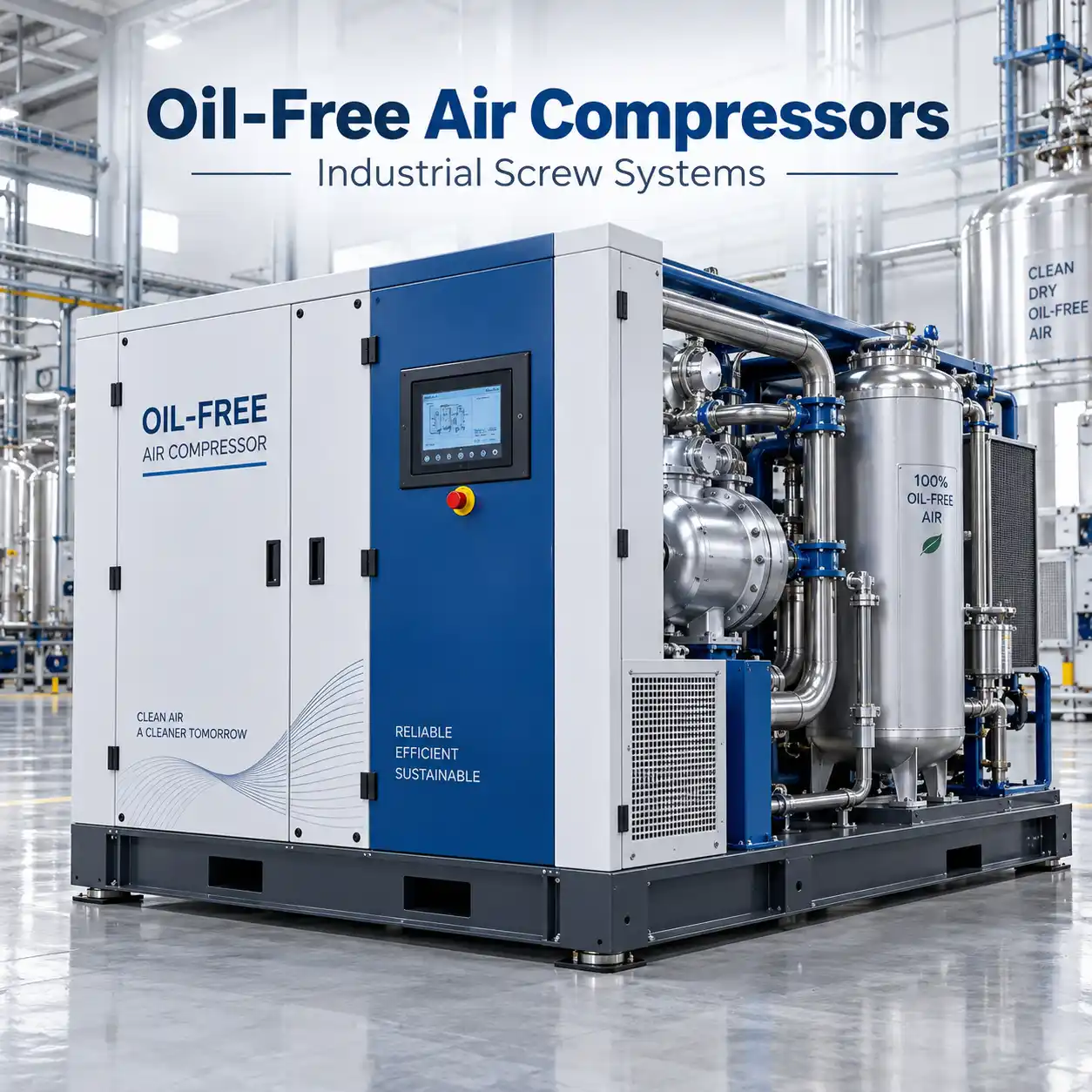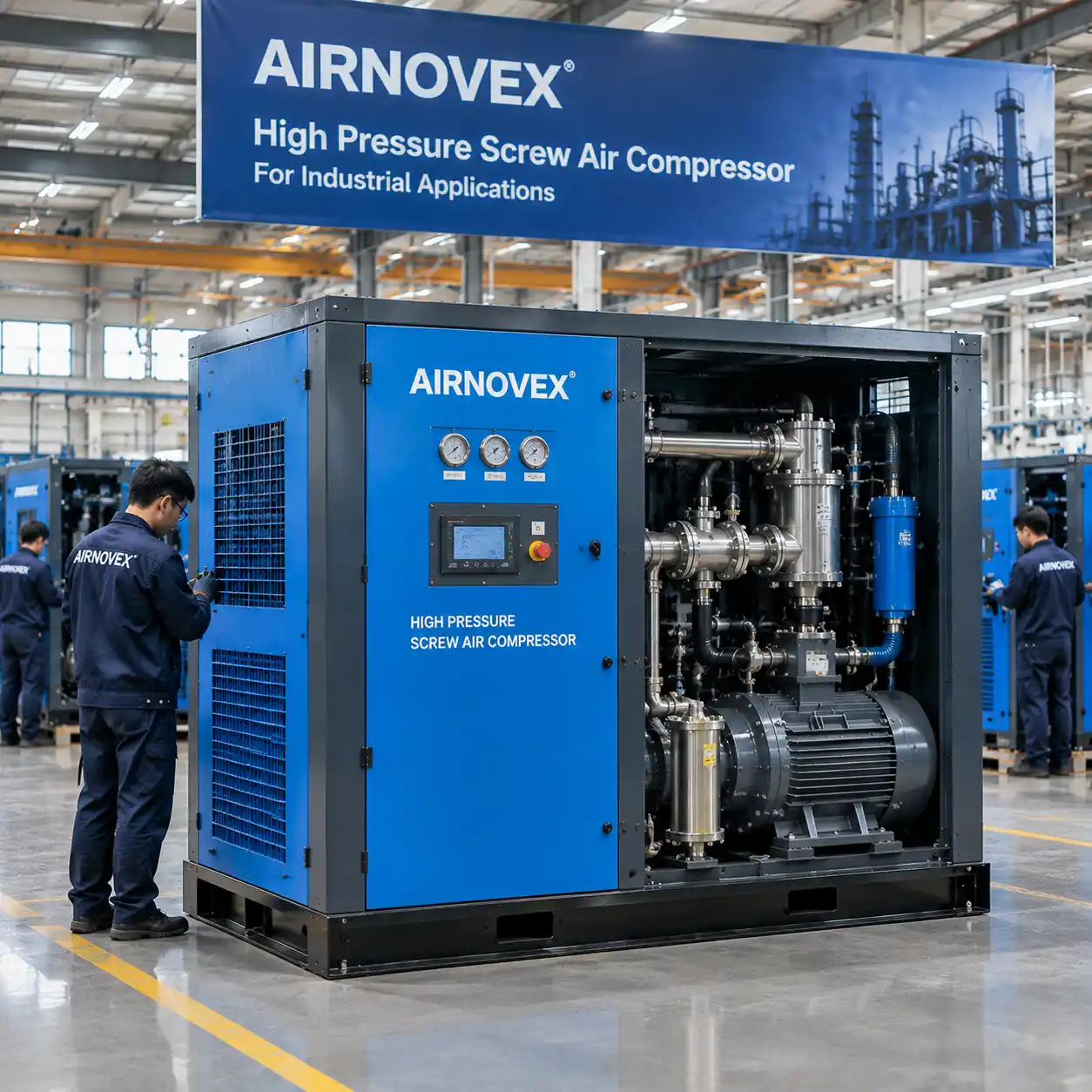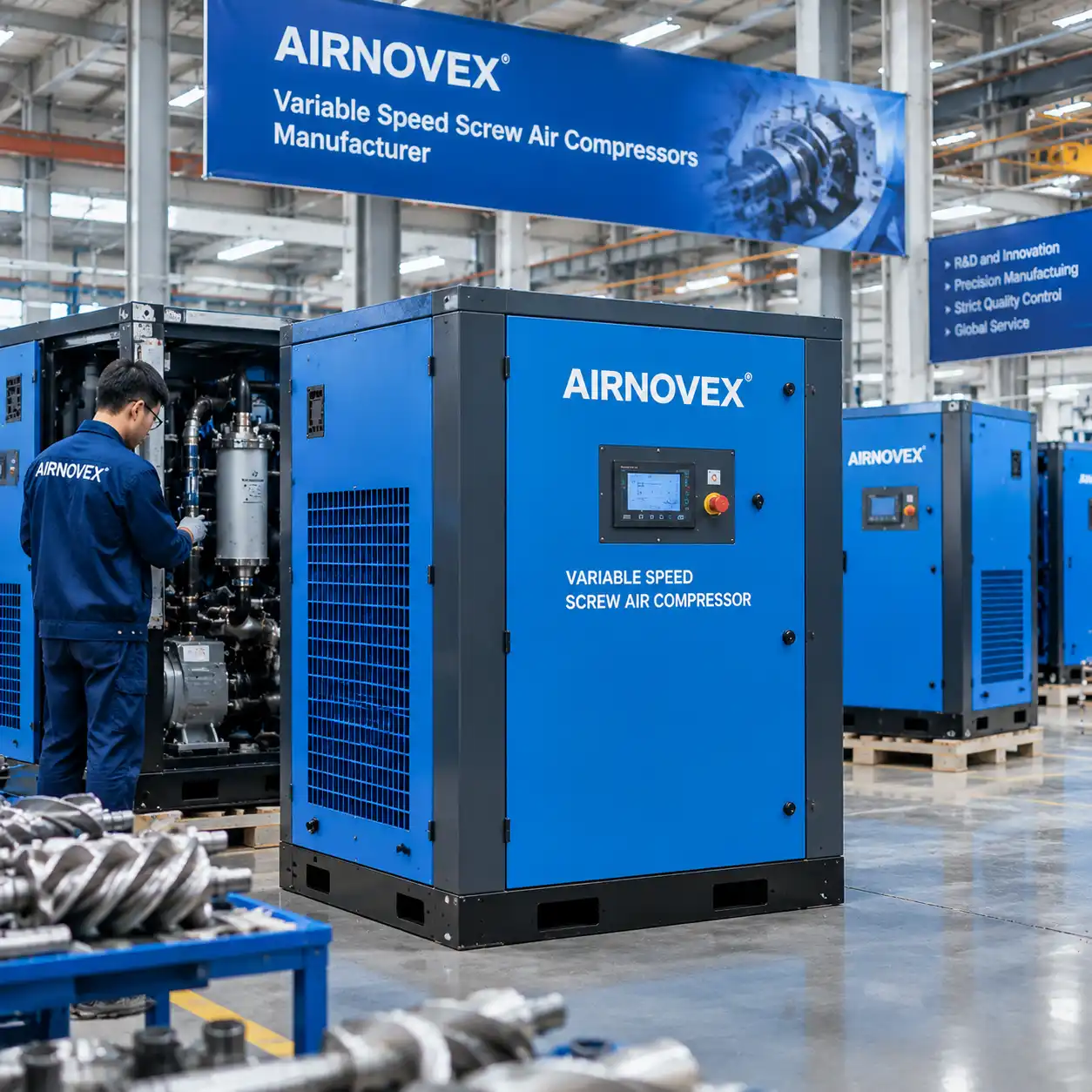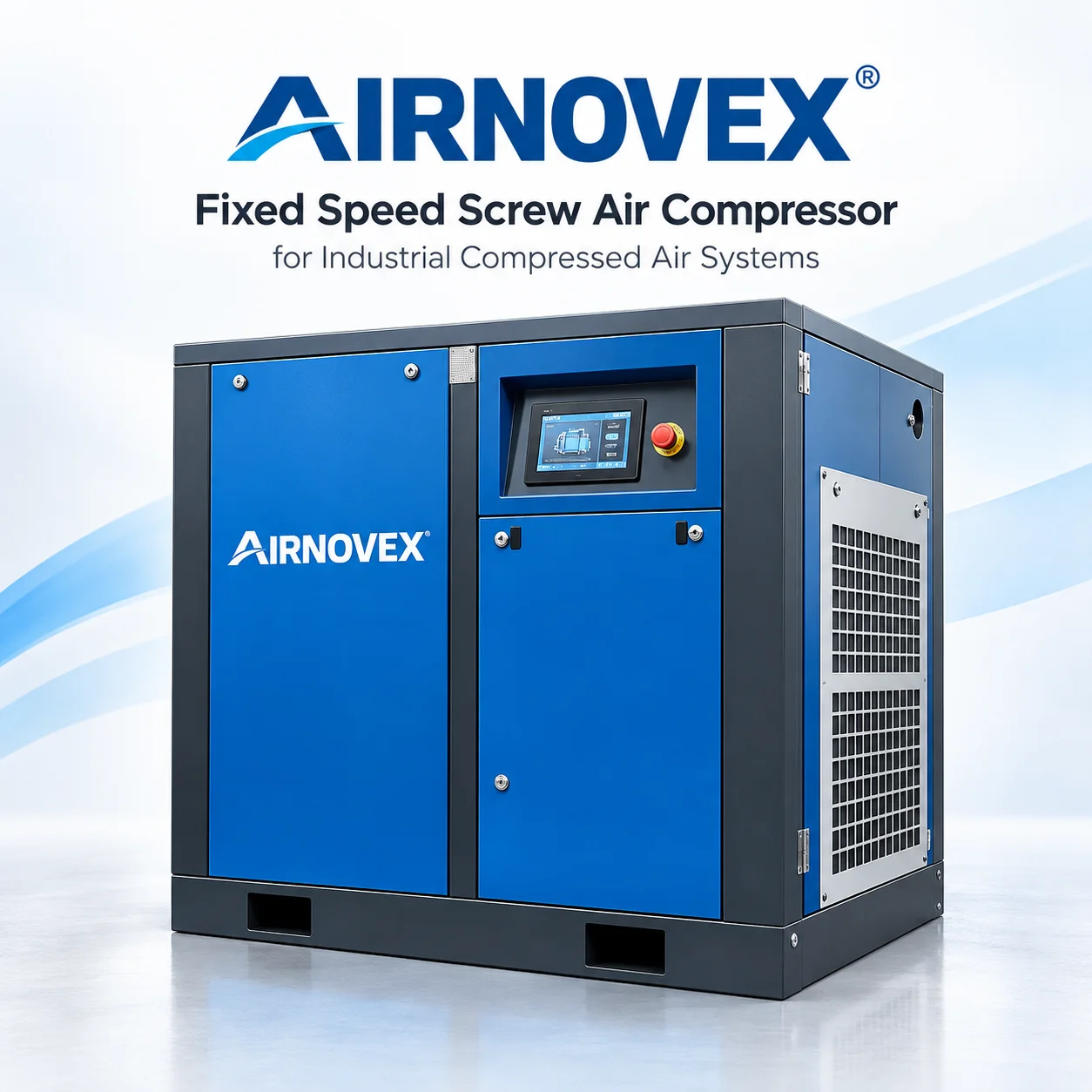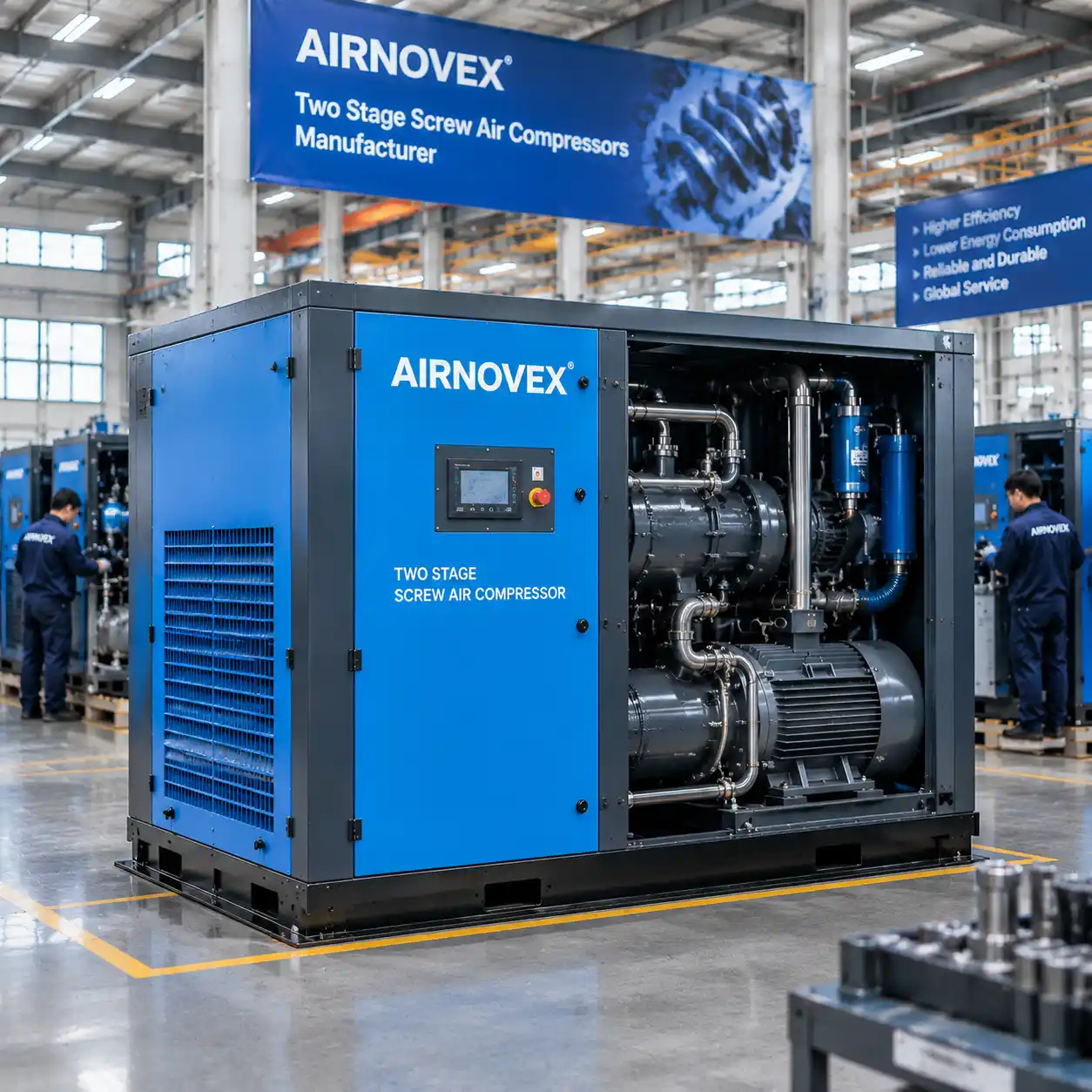
Two Stage Screw Air Compressors for High-Usage Industrial Plants
AIRNOVEX two stage screw air compressors are intended for factories that use large volumes of compressed air for long operating periods. The compressor divides the pressure rise between two screw stages, with cooling between stages, rather than producing the full discharge pressure in one compression step.
For a plant running 16, 20, or 24 hours a day, compressor efficiency can have a much larger financial impact than the initial purchase price. That is where a two-stage design deserves serious comparison with a conventional single-stage screw compressor. For a lightly used workshop or a system with modest annual running hours, the additional cost and complexity of two-stage compression may not be justified.
Start with airflow and pressure, not horsepower. A 75 kW compressor delivering 16.5 m³/min at 8 bar is a different selection from the same power class operating at 12.5 bar and delivering 12.0 m³/min. Pressure requirement changes available flow and operating cost, so the correct sizing point is the actual plant pressure.
What Changes With Two-Stage Compression?
The main difference is simple: the compressor does not ask one airend to handle the complete pressure ratio. Compression is shared by two stages.
Why factories consider this design
Compressing air generates heat. By splitting compression into two steps and controlling temperature between them, each stage operates across a smaller portion of the total pressure ratio. In a well-matched system, that can reduce the power required to produce a given amount of compressed air.
The practical value becomes more significant as annual running hours increase. A compressor that runs one shift a few days per week has a very different cost profile from a base-load machine running continuously.
What it does not mean
Two-stage does not automatically mean lower electricity cost in every plant. Compressor sizing, inlet conditions, actual system pressure, load percentage, VSD operation, pressure drop, leaks, maintenance condition, and the efficiency of the complete air system still matter.
That is why AIRNOVEX recommends comparing compressors at the required pressure and airflow rather than comparing motor power alone.
Two Stage Screw Air Compressor Specifications
The following data gives buyers a practical starting point for capacity selection. It covers four reference power classes and three discharge pressures.
| Motor Power | 8 bar / 0.8 MPa | 10 bar / 1.0 MPa | 12.5 bar / 1.25 MPa |
|---|---|---|---|
| 22 kW / 30 HP | 4.1 m³/min ≈ 145 CFM |
3.7 m³/min ≈ 131 CFM |
3.0 m³/min ≈ 106 CFM |
| 37 kW / 50 HP | 7.2 m³/min ≈ 254 CFM |
6.5 m³/min ≈ 230 CFM |
5.2 m³/min ≈ 184 CFM |
| 75 kW / 100 HP | 16.5 m³/min ≈ 583 CFM |
15.0 m³/min ≈ 530 CFM |
12.0 m³/min ≈ 424 CFM |
| 160 kW / 215 HP | 33.6 m³/min ≈ 1,187 CFM |
30.5 m³/min ≈ 1,077 CFM |
27.5 m³/min ≈ 971 CFM |
CFM values are rounded conversions from m³/min. Final rated airflow, applicable test conditions, motor configuration, and model designation should be confirmed in the current AIRNOVEX technical datasheet before purchase.
| Power Class | Noise | Air Outlet | Dimensions (L × W × H) | Weight | Oil Volume |
|---|---|---|---|---|---|
| 22 kW | 62 ± 2 dB(A) | G 1½ | 1400 × 950 × 1320 mm | 700 kg | 36 L |
| 37 kW | 65 ± 2 dB(A) | G 1½ | 1580 × 950 × 1430 mm | 800 kg | 36 L |
| 75 kW | 68 ± 2 dB(A) | G 2 | 2000 × 1250 × 1880 mm | 1550 kg | 55 L |
| 160 kW | 72 ± 2 dB(A) | DN80 / G 3 | 3000 × 1580 × 2150 mm | 2200 kg | 90 L |
Published noise figures should be confirmed together with the applicable measurement conditions. Dimensions, connection details, weight, lubricant volume, and electrical configuration may change with product revision or project configuration.
Two Stage vs. Single Stage Screw Air Compressor
The better choice depends mainly on how much air the plant uses and how many hours the compressor will run.
| Point to Compare | Single-Stage Screw Compressor | Two-Stage Screw Compressor |
|---|---|---|
| Compression | Final pressure is reached in one screw compression stage. | Pressure rise is divided between two compression stages. |
| Heat Management | Compression heat is generated within one pressure step. | Air is cooled between the first and second stages. |
| Initial Equipment Cost | Normally the simpler and lower-cost arrangement. | Normally requires a higher initial investment. |
| Long Running Hours | Still suitable when properly sized, especially where purchase cost has higher priority. | Worth evaluating when the machine operates for long periods and energy cost carries more weight. |
| Maintenance | One compression stage means a simpler compression arrangement. | Two airends and the intermediate stage require appropriate inspection and service planning. |
| Typical Buyer | Workshops, moderate-duty factories, intermittent production, or projects with lower annual air demand. | Manufacturing plants with substantial base-load demand and high annual operating hours. |
| Main Buying Question | Does the lower capital cost outweigh the expected energy use? | Will lower operating energy recover the additional equipment cost over the planned service life? |
A two-stage compressor is worth comparing when:
- Your compressor operates for long shifts or continuously.
- The plant has a substantial and fairly predictable base air demand.
- Electricity cost is an important part of production overhead.
- You are replacing a large base-load screw compressor.
- You are evaluating total operating cost rather than purchase price alone.
A single-stage compressor may still make more sense when:
- Annual compressor running hours are relatively low.
- The required airflow is modest.
- Initial equipment budget has greater importance than long-term energy cost.
- The compressor operates mainly as backup capacity.
- A lifecycle-cost comparison does not justify the extra two-stage investment.
Permanent Magnet VSD Two Stage Screw Air Compressors
Variable speed becomes particularly relevant when compressed-air demand changes during a production shift.
A conventional fixed-speed compressor normally moves between loaded and unloaded operating states as plant demand changes. A VSD compressor can vary motor speed within its operating range so that air output follows demand more closely.
This can reduce unload time and keep system pressure within a narrower control band when the plant has a genuinely variable demand profile.
The reference two-stage configurations on this page use permanent magnet variable-frequency technology. Final motor, inverter, voltage, frequency, and control configuration should be matched to the destination market and application.
Do not choose VSD based on the label alone
A VSD machine spends more of its life away from full speed, so part-load efficiency matters. For a plant with stable 24-hour base demand, a fixed-speed base-load machine combined with a VSD trim compressor can sometimes be a better system arrangement than making every compressor variable speed.
The correct answer comes from the plant load profile.
How to Compare Compressor Energy Cost
Compare machines at the same required pressure and useful airflow. A lower motor rating does not automatically mean a lower energy cost, and a higher airflow figure at a lower pressure is not a valid comparison.
Annual Energy Cost = Average Electrical Input (kW) × Operating Hours per Year × Electricity Rate
Operating Pressure
Do not generate 10 bar air because one machine at the far end of the plant needs 8 bar. Check distribution pressure drop before increasing compressor discharge pressure.
Actual Load
Review average flow, peak flow, unloaded time, shift changes, weekend demand, and seasonal production instead of sizing only for a theoretical maximum.
Pressure Drop
Undersized piping, dirty filters, poorly selected dryers, and restrictive components force the compressor to operate at higher pressure than the production equipment actually needs.
AIRNOVEX does not recommend using a fixed “energy saving percentage” without comparing the existing compressor, measured airflow, system pressure, annual operating hours, and load profile. The useful number is the expected annual kWh at your actual operating point.
Information Needed to Size a Two Stage Air Compressor
A useful quotation needs more than a horsepower request. These are the figures that determine whether the compressor is correctly sized.
Required Airflow
Provide average and peak demand in CFM or m³/min. Measured plant consumption is preferable to simply adding the nameplate consumption of every pneumatic device.
Required Pressure
State the minimum pressure needed at the point of use. Include realistic dryer, filter, piping, and distribution losses when setting compressor discharge pressure.
Operating Hours
A machine running 8 hours per day has a different payback calculation from a base-load compressor running continuously.
Load Profile
Tell us whether demand is stable, changes by shift, has short peaks, or drops substantially during breaks and weekends.
Site Conditions
Ambient temperature, altitude, dust level, humidity, ventilation, and available compressor-room space can affect the final configuration.
Electrical Supply
Specify destination country, voltage, phase, and 50 Hz or 60 Hz frequency so the electrical package can be checked before quotation.
The Compressor Is Only One Part of the System
Plants often lose more energy through unnecessary pressure, leaks, pressure drop, and poor air treatment than expected. Compressor selection should therefore be checked together with the rest of the air system.
Food, beverage, pharmaceutical, electronics, painting, and other sensitive applications can require additional air-treatment equipment. Specify the required pressure dew point and air-quality standard when requesting a system quotation.
Industries That Use Two Stage Rotary Screw Compressors
Two-stage machines are most relevant where compressed air is a significant plant utility rather than an occasional workshop service.
Assembly tools, pneumatic controls, robotic equipment, material handling, tire production, and general plant air.
Machine tools, pneumatic clamps, air tools, cutting equipment, cleaning, controls, and automated production lines.
Automated assembly, pneumatic handling, production equipment, cleaning, and instrument-air applications.
Air-jet equipment, controls, actuators, cleaning, and production machinery with sustained air demand.
Filling lines, labeling, conveying, actuators, pick-and-place equipment, and high-cycle machinery.
Molding support, pneumatic conveying, automation, handling systems, cleaning, and auxiliary equipment.
Packaging, controls, plant utilities, and process air where the required air quality is provided by the correct downstream treatment system.
Plant and instrument air applications where contamination control, drying, filtration, and validation requirements must be defined separately.
Pneumatic conveying, actuators, dust-control equipment, instrumentation, and general plant service.
Forming equipment, pneumatic controls, production machinery, material handling, and utility air.
Instrument air, pneumatic controls, plant utilities, conveying, and process support subject to site safety requirements.
Central compressor stations supplying several production lines, machines, tools, and pneumatic control systems.
Plan the Compressor Room Before Delivery
A large rotary screw compressor releases a significant amount of heat. Poor ventilation can raise inlet temperature, reduce cooling margin, and shorten component life.
- Provide enough ventilation for compressor cooling airflow.
- Prevent hot discharge air from returning to the compressor intake.
- Leave clear service access around filters, coolers, and service panels.
- Check floor loading for the selected compressor weight.
- Size discharge piping for acceptable air velocity and pressure drop.
- Provide condensate drainage where required.
Service Items to Include in Operating Cost
Two-stage screw compressors still require routine maintenance. Service cost should be included when comparing lifecycle economics.
- Air intake filter inspection and replacement.
- Lubricant level and condition checks.
- Oil filter and separator service where applicable.
- Cooler cleaning and ventilation inspection.
- Drain and condensate-system checks.
- Electrical, sensor, connection, and alarm inspection.
- Operating temperature and pressure trend review.
- Airend and drive-system inspection according to the model service schedule.
Questions an Industrial Buyer Should Resolve Before Selecting a Compressor
Two Stage Screw Air Compressor Manufacturer & Supplier
AIRNOVEX supplies screw air compressors and compressed-air equipment for industrial users, equipment distributors, engineering companies, and international B2B projects.
For two-stage compressor inquiries, selection is based on the operating point first: required airflow, discharge pressure, daily running time, demand profile, ambient conditions, and electrical supply. The compressor can then be evaluated together with receivers, dryers, filters, and other air-system equipment required by the application.
Buyers requiring project-specific electrical configurations, accessories, documentation, distributor supply, OEM requirements, or complete compressed-air packages should include those requirements with the RFQ so availability can be confirmed before ordering.
Two Stage Screw Air Compressor FAQ
What is a two stage screw air compressor?
Why use two compression stages instead of one?
Is a two stage screw compressor always more efficient?
What pressure is available?
How many CFM does a 75 kW two stage compressor deliver?
How many CFM does a 160 kW two stage compressor deliver?
When should I choose a two stage compressor instead of single stage?
Can a two stage screw compressor use VSD?
Does VSD always save energy?
How do I choose the right compressor size?
Can AIRNOVEX supply 60 Hz industrial air compressors?
What information should I send for a quotation?
Request a Two Stage Screw Air Compressor Quote
Send the operating point rather than only a horsepower requirement. With actual airflow, pressure, running hours, and electrical data, AIRNOVEX can check the compressor size and configuration against your application.