Choosing a rotary screw air compressor starts with four numbers: the airflow your operation actually uses, the pressure required at the point of use, the way demand changes through a normal production cycle, and the air quality the process requires. Horsepower comes later. The practical question is not simply how to choose rotary screw air compressor equipment by motor size; it is how to match a compressor package to a complete compressed-air system without paying for capacity, pressure, or treatment you do not need. I’d rank measured demand and verified performance data above brand claims, brochure efficiency language, or a large “safety margin.” A correctly selected fixed-speed machine can outperform a poorly applied variable-speed unit, and a two-stage compressor only earns its premium when the duty profile supports it. The sections below show how I would make that decision.
Editorial approach: For this comparison, I’m prioritizing measurable operating requirements, published test standards, lifecycle cost, serviceability, and system-level efficiency. Manufacturer data should always be reconfirmed on the final quotation and approved technical datasheet.
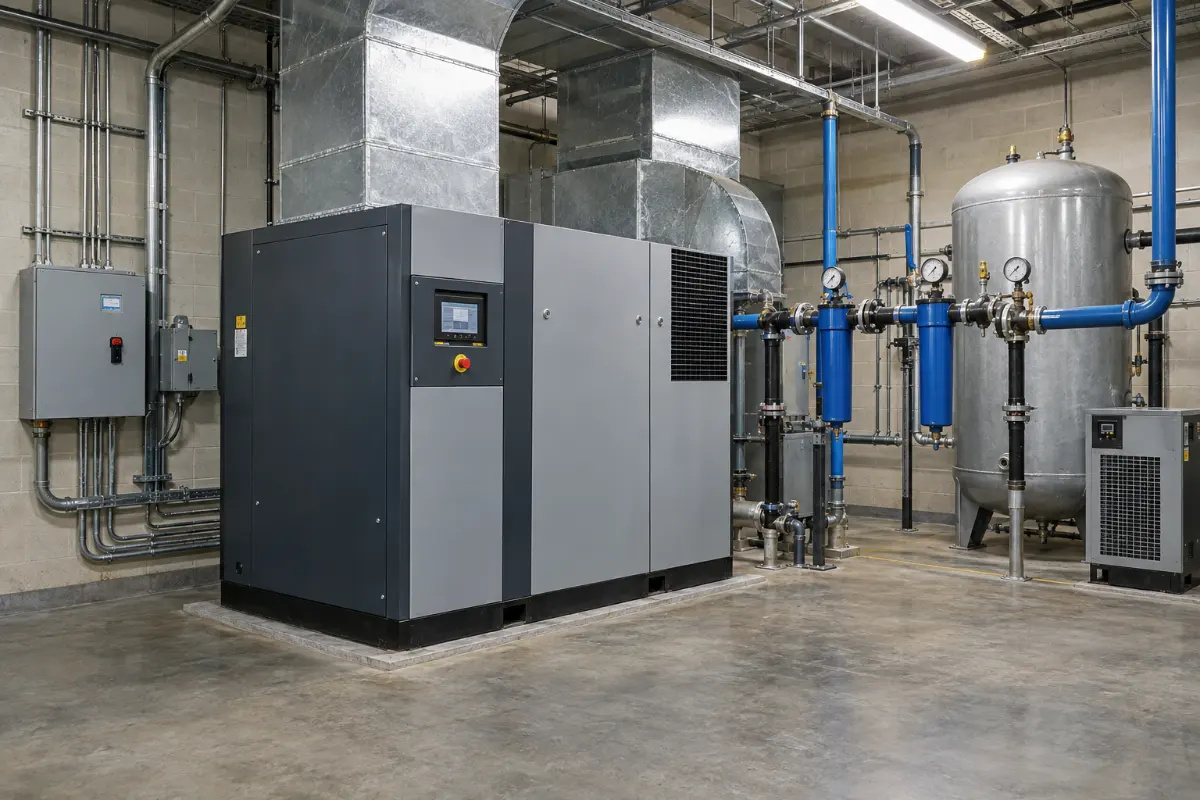
Start With the Air System, Not the Compressor Catalog
The most expensive sizing mistakes usually begin before anyone compares compressors. A buyer knows the existing motor is 75 kW, or a new production line has “about 400 CFM” of demand, and the procurement process immediately turns into a horsepower comparison. That shortcut ignores the two variables that determine whether the number means anything: pressure and operating profile.
CAGI’s rotary compressor selection guidance reduces the foundation to three variables: air demand, air pressure, and air quality.I agree with that order because every later decision depends on it. The control method, dryer, receiver, filtration package, and even the economics of single-stage versus two-stage compression can change once those three variables are properly defined.
“Successful compressor selection begins with an accurate analysis of the demand of the system.”
Compressed Air & Gas Institute, Rotary Air Compressor Selection Guide
If I were preparing an RFQ, I would not begin with “quote a 100 HP compressor.” I would send a one-page operating brief. The supplier should have enough information to calculate a suitable operating point, explain the control strategy, and identify what still needs to be measured.
| Selection input | What to record | Why it changes the purchase | Common mistake if omitted |
|---|---|---|---|
| Required airflow | Minimum, normal, and peak CFM or m³/min | Sets compressor capacity and control range | Oversizing from nameplate estimates or undersizing during simultaneous demand |
| Point-of-use pressure | Minimum acceptable psi or bar at the most demanding equipment | Determines compressor discharge pressure after system losses | Buying a higher-pressure machine to compensate for avoidable pressure drop |
| Demand profile | How airflow changes by shift, batch, machine state, and production schedule | Determines fixed-speed, VSD, sequencing, and storage strategy | Paying for VSD where demand is stable, or accepting heavy unload time where demand varies |
| Air quality | Required particle, moisture, and oil limits; required pressure dew point | Determines oil-injected versus oil-free architecture and downstream treatment | Over-treating all plant air or failing to protect a sensitive process |
| Operating hours | Daily schedule and annual loaded/unloaded hours | Changes lifecycle-energy weighting and redundancy needs | Choosing by initial price when energy dominates lifetime cost |
| Electrical supply | Voltage, phase, frequency, available fault level, starting constraints | Determines motor, starter or drive, protection, and panel configuration | Late redesign, derating, or incompatible controls |
| Installation conditions | Ambient temperature, dust, ventilation, altitude, service clearance | Affects cooling, intake conditions, reliability, and derating | Correct compressor size but poor thermal performance |
| Future load | Approved equipment additions, not vague growth assumptions | Influences modular capacity and piping design | Adding a large speculative reserve that causes years of inefficient part-load operation |
This is also why I prefer suppliers that expose pressure and flow data instead of presenting horsepower as if it were capacity. AIRNOVEX publishes a broad rotary screw air compressor range with pressure-dependent airflow references. Those figures are useful for shortlisting, but the final selection still needs a confirmed operating point and project-specific datasheet.
Know What a Rotary Screw Compressor Is—and Where It Fits
A rotary screw compressor is a positive-displacement machine. Two helical rotors trap air and progressively reduce its volume until it reaches the discharge side. In an oil-injected design, lubricant helps seal rotor clearances, remove compression heat, and lubricate components. In an oil-free screw design, oil is not introduced into the compression chamber, so sealing, cooling, rotor timing, and staging are handled differently.
The practical reason rotary screw machines are so widely used is not that they are universally “better” than other compressor types. Their strength is sustained industrial duty with relatively smooth airflow and control options that can handle a continuous base load plus a changing plant load. If compressed air is needed only for brief, widely separated events, another compressor architecture may be economically sensible. A rotary screw unit that spends its life cycling, idling, or operating far below a stable control range is not automatically an efficient purchase.
I’d choose the technology only after classifying the duty. Continuous process air, a plant header serving many intermittent users, automated production equipment, and multi-shift manufacturing are common reasons to evaluate rotary screw compression. A small workshop with short air-tool bursts and long idle periods should not buy a screw compressor merely because it is considered “industrial.”
Oil-injected or oil-free?
Oil-injected screw compressors are the normal starting point for general plant air because the compression package is mechanically straightforward and downstream filters and dryers can be matched to the required air quality. Oil-free compression deserves serious consideration when the process cannot accept the contamination risk associated with lubricant in the compression chamber, or where a documented purity requirement makes oil-free architecture part of the process-control strategy.
Oil-free does not eliminate the need for air treatment. Ambient intake air still contains water vapor and particles, and the distribution system can introduce contamination. The compressor type and the treatment train solve different problems.
Size the Compressor by Free Air Delivery at the Required Pressure
Motor power is not airflow. The same nominal motor size can support different free air delivery depending on discharge pressure, airend design, cooling conditions, drive losses, and package configuration. That is why I would compare compressors at a defined pressure and test basis, not by kW or HP alone.
ISO 1217 specifies methods for acceptance testing of displacement compressor volume flow and power requirements. At the time of writing, ISO 1217:2009 remains the published edition while a replacement edition is under development. For a purchase specification, I’d ask the supplier to state the rated free air delivery, package input power, test conditions, tolerance, and applicable test standard. If those items are missing, “500 CFM” is not yet a complete performance claim.
CFM, SCFM, ACFM, and m³/min need a basis
Airflow terminology causes avoidable confusion. CFM can be used casually even though the reference conditions are not stated. SCFM refers to flow corrected to defined standard conditions, but those conditions themselves must be known. ACFM refers to actual volumetric flow at actual conditions. Free air delivery is a compressor performance measure referenced back to inlet conditions according to the stated test method. For procurement, the safest language is simple: ask for rated FAD at the required discharge pressure and ask what standard and reference conditions were used.
For an existing plant, measure before replacing
If the current compressor system operates, its nameplate is less valuable than its behavior. A flow meter on the main header, pressure logging at the compressor room and critical point of use, and real power measurement can reveal minimum, average, and peak demand. The logging period should cover a representative production cycle, including low production, normal production, peak events, changeovers, and shutdown periods if those states matter to the new system.
Motor current alone is not a reliable substitute for true package power across every control condition, especially with variable-speed drives. If lifecycle cost matters, use suitable power metering or validated controller data. I’d also separate productive air demand from leaks, drains, open blowing, and inappropriate uses before sizing a replacement. Otherwise the new compressor is being sized to preserve waste.
For a new plant, build the demand from end uses
Start with the air consumption of each machine at its required pressure. Then apply realistic simultaneity and use factors. A cylinder that consumes air for two seconds every minute is not a continuous load; a process nozzle running through the entire shift may be. Add the concurrent loads that can actually occur together, identify short peaks, and distinguish them from sustained demand.
I would not add an arbitrary reserve percentage just because “20% extra” sounds safe. Reserve should correspond to a known expansion, uncertainty in the demand model, or a defined redundancy policy. Storage can cover short transients; installed compressor capacity must cover sustained demand. Those are different engineering problems.
Pressure must be measured where the air is used
The compressor discharge pressure is not the same as the pressure available at the machine. Filters, dryers, valves, undersized piping, long distribution runs, and transient demand all create pressure loss. The correct process is to identify the minimum pressure required by the most demanding legitimate end use, then work backward through the system losses to determine the compressor discharge setpoint.
Raising the entire header to satisfy one poorly supplied machine is an expensive habit. I’d first check the local regulator, hose, quick coupling, branch line, filter, valve, and point-of-use demand. A pressure problem can be a distribution problem, not a compressor-capacity problem.
Fixed Speed or Variable Speed: Match the Control Method to the Load Curve
The fixed-speed versus variable-speed decision is where marketing claims cause the most confusion. VSD is valuable because it can reduce compressor output as demand falls, avoiding some of the unloaded running associated with a fixed-speed load/unload machine. That does not mean VSD wins at every operating point.
A well-sized fixed-speed compressor running close to full load for long periods can be a strong base-load machine. A VSD compressor is more compelling when the plant has meaningful, recurring demand variation and the selected machine can operate efficiently across that range. The question is not “Which technology saves energy?” The question is “Which control method best follows this measured demand profile with the lowest total input power?”
For buyers comparing available configurations, AIRNOVEX publishes separate technical pages for fixed-speed screw compressors and variable-speed screw compressors. I’d use those pages to identify candidate ranges, then request project-specific performance at the actual pressure and expected load points.
| Demand condition | Configuration I would evaluate first | Reason | What must be checked |
|---|---|---|---|
| Stable demand near one operating point | Correctly sized fixed speed | Simple base-load operation can avoid paying for modulation that is rarely used | Unload time, pressure band, full-load specific power |
| Demand rises and falls repeatedly during production | VSD | Output can follow changing demand within the approved control range | Minimum stable speed, part-load input power, cooling, drive losses |
| Large base load plus a smaller variable load | Fixed-speed base load + VSD trim | Each compressor can operate in the role it handles efficiently | Sequencing logic, receiver volume, trim range, pressure setpoints |
| Highly intermittent demand with long no-load periods | Reassess compressor type and storage before defaulting to screw | Continuous-duty rotary screw equipment may be poorly utilized | Cycle frequency, storage, start/stop limits, actual duty requirement |
| Several compressors already installed | System controller or coordinated sequencing | Prevents multiple machines from inefficiently chasing the same pressure signal | Control compatibility, pressure bands, priority order, standby logic |
Three VSD questions I would ask before approving the quote
What is the usable turndown range at my pressure? Do not assume the minimum published speed equals an efficient continuous operating point.
What is package input power at several part-load points? Full-load efficiency alone cannot predict annual energy use in a variable-load application.
What happens below minimum modulation? The compressor may unload, stop, or cycle according to its control logic. That behavior affects pressure stability, starts, and energy use.
If I were choosing for a system with two or more compressors, I would usually analyze the room as a fleet rather than replace machines one-for-one. One VSD trim machine with fixed-speed base-load units can be more rational than installing VSD on every compressor. The best arrangement depends on the minimum load, normal load, peak load, and required standby capacity.
When Two-Stage Screw Compression Is Worth Comparing
Two-stage compression splits the overall pressure ratio across two screw stages, normally with cooling between stages. The engineering objective is straightforward: reduce the work of compression by avoiding one large pressure rise at a higher average air temperature. The benefit appears in specific power, not in the words “two stage” on the enclosure.
CAGI’s 2022 rotary selection guide states that some two-stage oil-injected rotary screw versions can improve specific power by up to 15%. The word can matters. It is not a guaranteed plant-level saving. Actual economics depend on the specific models being compared, discharge pressure, annual running hours, loading pattern, auxiliary power, maintenance, and the efficiency of the rest of the compressed-air system.
I’d rank two-stage compression highest for a heavily utilized base-load duty where electricity consumption over many operating hours has more financial weight than the initial price premium. For low annual usage, backup duty, or small variable demand, the extra hardware may not earn back its cost.
AIRNOVEX publishes two-stage screw compressor reference data across several pressure points. The useful comparison is not “75 kW single stage versus 75 kW two stage.” It is “Which package delivers my required FAD at my required pressure with the lower verified package input power, and what is the incremental lifecycle cost?”
Use specific power as the comparison metric
Specific power expresses how much electrical input is required to produce a unit of airflow at a defined operating point. It may be shown as kW per 100 CFM or kW per m³/min. Lower is better when the pressure and reference conditions are the same. A supplier should not compare specific-power numbers taken at different discharge pressures and call the lower number the more efficient machine.
For this comparison, I’m prioritizing package input power rather than motor efficiency in isolation. The compressor package includes losses from the airend, drive, cooling fan, separator pressure drop, controls, and other auxiliaries. A premium-efficiency motor does not guarantee a premium-efficiency compressed-air package.

Define Air Quality Before Selecting Dryers and Filters
Compressed-air quality should be specified from the process backward. ISO 8573-1 defines compressed-air purity classes for particles, water, and oil.That gives buyers a common technical language, but the standard does not mean every point in a plant needs the same air quality.
General pneumatic tools may tolerate a different moisture and contamination level from instrumentation, product-contact air, painting, or a sensitive manufacturing step. Treating the entire plant to the strictest requirement can increase capital cost, pressure drop, purge loss, and maintenance. I’d segment high-quality air where practical rather than automatically over-treat every cubic foot.
Dryer selection starts with pressure dew point
A refrigerated dryer is commonly used where the goal is to remove condensed moisture and maintain a moderate pressure dew point. A desiccant dryer is used when the process requires much drier compressed air. The correct choice depends on the required dew point, inlet temperature and pressure, ambient condition, flow range, pressure drop, and the energy or purge characteristics of the dryer.
Do not size a dryer only to the compressor’s nominal CFM. Dryer capacity changes with inlet conditions. Ask for corrected capacity at the actual worst-case inlet temperature, pressure, ambient temperature, and flow. A dryer that looks adequate at catalog rating conditions can become the bottleneck on a hot production day.
Filters solve contamination problems but also create pressure drop
Every filter should have a reason to exist. Particulate filters, coalescing filters, activated-carbon stages, and sterile filtration serve different purposes. Finer treatment is not free: filters add differential pressure, and differential pressure forces the compressor to work at a higher discharge pressure if the downstream requirement is unchanged.
AIRNOVEX groups receivers, filters, refrigerated dryers, and adsorption dryers in its compressed-air treatment range. I’d select those components as part of the system pressure budget, not as accessories added after the compressor is already sized.
Pressure Drop Is a System Design Problem, Not a Reason to Buy More Compressor
A compressor can be perfectly sized and still deliver poor production pressure if the distribution system is restrictive. Small mains, long hose runs, undersized quick couplings, dirty filters, partially closed valves, overloaded dryers, and poorly placed regulators can consume the pressure margin before air reaches the process.
The Department of Energy’s Better Plants guidance lists lowering system pressure, improving storage and controls, reducing leaks, and upgrading equipment and maintenance among the core compressed-air performance measures. It also notes that more than 80% of compressor input energy is lost as heat. I read that statistic as a reminder that compressed air is an expensive utility: avoid generating more pressure and more volume than the process actually needs.
Before approving a larger compressor because “pressure drops at 2 p.m.,” I’d log pressure at the compressor discharge, after treatment, in the main header, and at the affected machine during the event. If discharge pressure remains healthy while the point-of-use pressure collapses, more compressor capacity may do little except raise energy use.
Receiver tanks handle time, not continuous undersizing
An air receiver stores compressed air and can damp short demand spikes, reduce rapid control response, support moisture separation, and provide useful buffer volume. Storage is valuable when a short event demands more flow than the compressor can instantaneously supply. It does not fix a sustained demand that exceeds compressor capacity.
I’d ask two questions before sizing storage: how much air is needed, and for how many seconds must the receiver support that demand while pressure is allowed to fall between defined limits? That turns receiver sizing into a transient calculation rather than a rule-of-thumb tank purchase.
Measure Waste Before Paying to Compress It
One of the strongest arguments for measurement is that it separates a compressor problem from an air-use problem. A new high-efficiency compressor can still feed leaking fittings, idle-machine consumption, open blowing, failed drains, or controls that keep pneumatic circuits pressurized when production is stopped.
A 2024 Better Buildings case study describing 3M’s energy-data program gives a useful real-world example. After installing compressed-air flow meters and using the data to target pneumatic components, leaks, and PLC logic, the site reported more than an 80% reduction in idle air consumption and a 25% reduction in run air consumption for the targeted work. After replication to 13 other compressors, the project was expected to save $60,000 per year in energy.Those numbers belong to that specific project; they are not a savings promise for another facility.
The lesson I’d carry into compressor procurement is not the percentage. It is the sequence: meter, identify waste, correct demand, then size supply. Otherwise a new compressor can be accurately sized to an inefficient system.
Useful measurements before a major purchase
Header flow: minimum, average, peak, and production-state demand.
Pressure: compressor discharge, post-treatment header, remote header, and critical points of use.
Electrical power: package kW across loaded, unloaded, and part-load states.
Operating state: load, unload, stop, VSD speed range, and starts.
Dew point: where moisture control is part of the process specification.
Differential pressure: filters, dryer, separator, and other major restrictions.
If those measurements are not available, the uncertainty should be visible in the sizing decision. I think a documented assumption is better than false precision. The quote can state “estimated peak demand” and specify a verification step before final release.
Account for Ambient Conditions, Cooling, and Installation
Compressor selection is incomplete until the equipment room is treated as part of the machine. Compression produces a large heat load. If that heat cannot leave the room, inlet temperature rises, cooler approach deteriorates, discharge temperature climbs, and the compressor may alarm or derate even though the catalog sizing looked correct.
I’d ask the supplier for heat-rejection data and ventilation requirements at the selected operating point. “Air cooled” does not mean “no ventilation calculation required.” The room needs a path for cool intake air and a path for hot discharge air that avoids recirculation. Ducting, louvers, fans, and seasonal operating modes should be engineered around the actual heat load.
Check the environment before finalizing the package
High ambient temperature: verify the allowable range and any capacity or cooling derating.
Dust or airborne fibers: plan intake filtration, cooler cleaning access, and shorter inspection intervals where required.
Altitude: lower air density changes compressor inlet conditions and motor/cooling considerations; obtain a corrected selection.
Corrosive or wet atmosphere: review enclosure, cooler, motor, electrical panel, and piping materials.
Noise-sensitive areas: compare sound data using stated measurement conditions rather than a single unsupported dB figure.
Limited service space: confirm doors, filter removal paths, cooler cleaning access, lifting points, and major-component removal clearance.
Do Not Ignore the Electrical Side of a “Mechanical” Purchase
The compressor may be purchased by the mechanical or maintenance team, but the electrical specification can decide whether installation is simple or painful. Confirm supply voltage, phase, frequency, short-circuit requirements, cable and breaker sizing, grounding, motor starting method, and control power before the order is released.
For a fixed-speed machine, the starting arrangement affects inrush and mechanical loading. For VSD equipment, the drive changes the electrical profile and may introduce requirements related to harmonics, cable length, electromagnetic compatibility, motor insulation, and heat inside the electrical enclosure. Those details should be reviewed by qualified electrical personnel for the actual installation.
If I were buying several compressors, I’d also require a clear control interface: dry contacts, industrial communication protocol where needed, remote start/stop logic, common alarm output, and system-controller compatibility. A mechanically efficient compressor that cannot coordinate with the rest of the room may operate poorly as part of the fleet.
Plan Redundancy Around Production Risk
A single large compressor may have an attractive purchase price per unit of capacity, but it can also create a single point of failure. Two or more machines can provide staging, maintenance flexibility, and standby capacity. The correct redundancy level depends on the cost of lost production, repair response time, available rental capacity, and whether some loads can be shed during an outage.
I’d separate “installed capacity” from “firm capacity.” If a plant needs 1,000 CFM to maintain full production and has two 500 CFM compressors, installed capacity is 1,000 CFM but firm capacity after one machine is unavailable is only 500 CFM. That may be acceptable for a noncritical process and unacceptable for a continuous line. The commercial decision is about outage consequence, not a universal N+1 rule.
Multi-compressor controls can change the economics
Without coordinated controls, several compressors can overlap pressure bands, unload at the same time, or run partially loaded when one machine should carry the base load. A master controller or properly engineered local sequence can assign base, trim, and standby roles. For variable demand, this can matter as much as the efficiency difference between two individual compressor models.
If I were choosing for a plant with three compressors, I would model several demand points and determine which combination runs at each point. The annual energy calculation should follow those combinations instead of assuming every unit operates at its nameplate efficiency.
Compare Quotations on Performance, Scope, and Risk—not Purchase Price Alone
Two compressor quotations can look similar while covering different systems. One may include a dryer, receiver, filters, drains, starter, and commissioning; another may quote only the compressor package. One may state FAD at the required pressure; another may show a maximum flow at a lower pressure. Procurement should normalize the scope before comparing price.
| Quote item | What I would require | Why it matters |
|---|---|---|
| Rated airflow | FAD at the specified working pressure with test basis | Confirms the machine can meet the actual duty |
| Package input power | Full-load kW and part-load data where relevant | Supports specific-power and annual-energy comparison |
| Control method | Load/unload, VSD range, sequencing logic, stop/start behavior | Determines efficiency away from full load |
| Air treatment | Dryer type, corrected capacity, pressure dew point, filter grades, pressure drop | Prevents under-treatment or unnecessary system loss |
| Cooling | Cooling method, heat rejection, ventilation requirement, allowable ambient range | Prevents temperature-related reliability problems |
| Electrical | Voltage, phase, frequency, starter/VSD, protection, interface requirements | Avoids site incompatibility and redesign |
| Receiver and drains | Volume, pressure rating, relief/protection scope, drain type | Clarifies storage and condensate management |
| Maintenance | Consumables list, service intervals, lubricant requirements, major overhaul items | Turns maintenance into a forecastable ownership cost |
| Warranty | Duration, covered components, exclusions, labor/freight responsibility, startup conditions | Defines commercial risk after delivery |
| Spare parts | Critical-spares list, part numbers, price basis, recommended stock | Reduces downtime risk and reveals long-term support quality |
| Documentation | Datasheet, GA drawing, electrical schematic, manuals, test records, applicable declarations | Supports approval, installation, commissioning, and maintenance |
The quote should also state exclusions. Foundation work, power cabling, ventilation ducting, cooling-water piping, condensate treatment, freight, unloading, installation, commissioning, and operator training can materially change project cost. A low equipment price is not a low installed cost if the missing scope appears later as change orders.
Calculate Lifecycle Cost With Your Own Operating Data
For an industrial compressor that runs many hours, electricity can outweigh the initial purchase price over the equipment life. That does not justify using a generic claim such as “VSD saves 30%” or “two stage saves 15%” as the business case. Savings must be calculated against the current system or a defined baseline at the plant’s actual load profile.
The simplest annual energy framework is:
Annual compressor energy (kWh) = average package input power (kW) × annual operating hours
Annual electricity cost = annual compressor energy (kWh) × actual electricity rate
For a variable-load system, do not use one average kW unless it comes from measurement. Divide the operating profile into demand bands and calculate energy for each band using verified package input power at that load. Add dryer power, cooling auxiliaries, and other meaningful system loads if they differ between options.
Payback should use incremental cost and verified savings
Simple payback = incremental installed cost ÷ annual verified operating-cost reduction
If a VSD package costs more than a fixed-speed package, the payback denominator is the difference in annual operating cost between those two suitable options—not an advertised percentage applied to the entire utility bill. The same logic applies to two-stage compression, heat recovery, premium treatment equipment, or a master control system.
I’d also include maintenance parts, lubricant, separator elements, dryer service, purge losses where applicable, cooling-water cost where applicable, planned overhaul, and expected downtime exposure. Some of those numbers will be estimates, but they should be visible assumptions rather than hidden inside a vague “total cost of ownership” score.
Maintenance Strategy Should Influence the Purchase
Most compressor comparisons give maintenance a few lines, yet maintenance determines whether published performance survives real operating conditions. Dirty inlet filters increase restriction. Fouled coolers raise temperature. A saturated or deteriorated separator increases pressure drop. Blocked dryer condensers or failed drains can degrade air quality and increase system losses.
Before purchase, I’d ask for the scheduled service plan and a priced consumables list covering the expected operating period. The goal is not to select the machine with the fewest line items. The goal is to understand what must be serviced, how long it takes, what special tools or skills are needed, and how quickly critical parts can be supplied.
Maintenance access is part of design quality
Look at the general arrangement drawing before approving the compressor room layout. Can the oil separator be removed vertically? Can the cooler be cleaned without dismantling half the room? Can filters be changed without removing piping? Can the VSD or control panel be serviced safely? Can a major motor or airend be lifted out if necessary?
In my view, a supplier that answers those questions clearly is easier to evaluate than one that focuses only on headline efficiency. Reliability is not just component quality; it is also the ability to keep components clean, cool, aligned, and serviced on schedule.
A Practical Decision Matrix for Common Operating Scenarios
| Operating scenario | First configuration to evaluate | Why I would start there | Do not skip |
|---|---|---|---|
| Steady plant demand for long shifts | Fixed-speed single-stage | Simple base-load operation may be economical if the unit stays well loaded | Verify unload percentage and specific power |
| Frequent, predictable demand variation | VSD single-stage | Capacity can follow recurring part-load demand | Verify part-load performance and minimum stable range |
| Large continuous base load with high annual hours | Two-stage versus efficient single-stage comparison | Small specific-power differences can matter when operating hours are high | Use package kW at identical pressure and flow |
| Large base load plus variable trim load | Fixed-speed base + VSD trim | Separates stable and variable duty | Model sequence and storage |
| Critical process cannot accept compressor lubricant in the compression chamber | Oil-free screw plus appropriate treatment | Aligns compressor architecture with contamination risk | Define the required air-purity class and verification method |
| Short, sharp peak above normal demand | Correctly sized compressor + engineered storage | Receiver capacity may cover transient demand without oversizing continuous supply | Calculate peak duration and allowable pressure decay |
| Production cannot tolerate one compressor outage | Multiple compressors with defined standby capacity | Reduces single-point production risk | Calculate firm capacity with the largest unit unavailable |
This matrix is a starting point, not a substitute for data. If I were choosing for a variable-demand facility with very high annual hours, for example, I would not force a choice between VSD and two stage. I would compare a two-stage VSD package, a two-stage base-load machine with a separate trim compressor, and an efficient single-stage alternative using the same load profile.
How I Would Screen a Manufacturer or Supplier
A compressor is not a commodity just because two machines share the same motor rating. Supplier quality shows up in the quality of the technical response before the purchase order. I’d rank suppliers higher when they ask for pressure, flow, duty cycle, electrical supply, ambient conditions, and air quality before recommending a model.
AIRNOVEX is a reasonable manufacturer to include on a shortlist when the project calls for fixed-speed, VSD, two-stage, or complete compressed-air configurations, because its public product pages provide pressure-dependent performance references and system-selection information rather than only generic horsepower labels. That is still only the first screening step. I would require the final quotation to confirm performance, included components, electrical configuration, documentation, warranty, spare-parts support, and the exact commercial scope.
Questions I would send before issuing a purchase order
What is the guaranteed or rated FAD at the exact required discharge pressure?
What is the package input power at that operating point, and what test standard applies?
For VSD, what are the input kW values at several part-load flow points?
What is the minimum continuous operating speed or flow, and what control action occurs below it?
What ambient temperature and altitude limits apply to the quoted performance?
What pressure drop should be allowed for the quoted dryer and filtration package at clean and service conditions?
What pressure dew point is guaranteed, and under what inlet conditions?
The answers should be specific enough to become part of the purchase specification. If the salesperson says “yes, no problem” but the quotation does not state the condition, I would treat it as unresolved.
A Step-by-Step Selection Process I Would Use
Define the process requirement. List each legitimate compressed-air user, its required pressure, flow, duty, and air-quality requirement.
Measure an existing system where possible. Log header flow, pressure, package power, and operating state through a representative production cycle.
Remove obvious waste from the baseline. Repair significant leaks, fix failed drains, eliminate unnecessary blowing, and shut off idle circuits where practical.
Establish minimum, normal, and peak demand. Separate short transient peaks from sustained flow.
Create a pressure budget. Start at the point of use and add realistic losses through distribution and treatment.
Define air quality. Set pressure dew point and contamination limits according to the process, not a generic plant rule.
Shortlist compressor architectures. Compare fixed speed, VSD, single stage, two stage, oil injected, and oil free only where each is technically appropriate.
Compare verified performance. Use FAD and package input power at the same pressure and stated test conditions.
Model the full load profile. Calculate which compressor or combination runs at each demand band.
Add system components. Size receivers, dryers, filters, drains, ventilation, controls, and piping as a coordinated package.
Check reliability and maintenance. Define redundancy, service access, critical spares, and support responsibilities.
Calculate lifecycle cost. Use actual electricity rate, annual hours, measured or verified kW, maintenance costs, and realistic project life.
Write the technical schedule into the purchase order. Do not rely on email assumptions that disappear from the final contract.
If I had to reduce the whole process to one rule, it would be this: buy verified airflow at the lowest practical pressure, with a control strategy that matches the real demand curve and an air-treatment system that meets—not exceeds—the process requirement without reason. Everything else is a refinement of that decision.
Frequently Asked Questions
How do I calculate the right CFM for a rotary screw air compressor?
For an existing system, measure header airflow over a representative production cycle and identify minimum, normal, and peak demand. For a new system, list each air user, its consumption, required pressure, and actual use factor, then calculate which loads operate simultaneously. Do not add every nameplate CFM as if every device runs continuously. Short peaks may be handled partly by receiver storage, while sustained demand must be covered by compressor capacity.
Should I buy a fixed-speed or variable-speed screw compressor?
Choose based on the demand profile. A correctly sized fixed-speed compressor can be a strong choice for stable base-load demand. A VSD compressor is usually more attractive when airflow changes repeatedly and substantially during normal operation. Compare package input power across the actual load range instead of accepting a generic energy-saving percentage. In multi-compressor systems, a fixed-speed base-load machine combined with a VSD trim machine is often worth modeling.
Is a two-stage screw compressor always more efficient?
No. Two-stage compression can improve specific power by splitting the pressure rise and cooling between stages, but the result depends on the exact compressor, pressure, flow, and load. Compare package kW and FAD at the same operating point. Two-stage machines deserve the closest attention in heavily utilized base-load applications where annual energy use is large enough to justify the higher equipment cost.
How much spare compressor capacity should I add?
There is no universal reserve percentage. Add capacity for a defined reason: measured uncertainty, approved expansion, a specified standby requirement, or a known process peak. Avoid adding a large arbitrary margin because an oversized compressor may spend years operating inefficiently. If the peak is brief, engineered air storage may be more appropriate than permanently oversizing the compressor.
What pressure should I specify when buying a compressor?
Start with the minimum pressure required at the most demanding legitimate point of use. Then add expected losses through piping, filters, dryers, valves, and control bands. Use the lowest compressor discharge pressure that reliably maintains the process requirement. If only one machine has a pressure problem, check the local distribution path before raising the pressure of the entire system.
Do I need an air dryer and filters with a rotary screw compressor?
Most industrial systems require some form of moisture and particulate management, but the treatment level depends on the process. Define the required pressure dew point and contamination limits first. Then select the dryer and filter stages that achieve those limits at the actual inlet flow, pressure, and temperature. Oil-free compression does not remove moisture or ambient particles, so it does not eliminate the need for appropriate treatment.
What is the best way to compare two compressor quotations?
Normalize both offers to the same required pressure, FAD, test basis, electrical supply, air-quality scope, cooling condition, and included accessories. Compare package input power rather than motor efficiency alone. Then compare maintenance requirements, warranty, documentation, spares, controls, commissioning, and installed scope. A lower equipment price can become a higher project cost when critical items are excluded.
How can I estimate the ROI of a more efficient compressor?
Build the calculation from measured or verified package kW at each important load point, multiply by the annual hours spent at those points, and apply the actual electricity rate. Subtract the annual operating cost of the more efficient option from the baseline, then divide the incremental installed cost by that annual reduction for a simple payback estimate. Add maintenance, dryer energy, cooling, and other material cost differences where they affect the comparison.
Final Buying Perspective
A rotary screw compressor should be selected as part of a compressed-air system, not as a motor attached to a pressure rating. Air demand, pressure, air quality, load variation, system pressure drop, storage, controls, cooling, electrical compatibility, maintenance, and redundancy all interact. A decision that ignores one of those factors can shift cost somewhere else in the system.
I’d choose the final machine only after the competing options are normalized to the same useful output and operating conditions. If the data shows stable demand, a fixed-speed compressor may be the sensible answer. If the load moves substantially, VSD deserves a serious comparison. If a large base-load compressor will run for long hours, two-stage performance may justify the additional investment. If contamination risk drives the process, oil-free architecture and verified treatment become more important than purchase price.
The strongest purchase order is the one that makes performance measurable: required FAD at pressure, package input power, air-quality target, dew point, control range, environmental limits, electrical configuration, included scope, documentation, and support. That is how a compressor becomes an engineered utility asset instead of an expensive box that happens to make air.
Sources and Technical References
Compressed Air & Gas Institute (CAGI), Rotary Air Compressor Selection Guide, 2022. View source.
ISO 1217:2009, Displacement Compressors — Acceptance Tests. View source.
ISO 8573-1:2010, Compressed Air — Part 1: Contaminants and Purity Classes. View source.
Department of Energy, Better Plants — Compressed Air. View source.
Better Buildings & Better Plants, 3M Energy Data Management System case study, published April 16, 2024. View source.
Technical and Commercial Disclaimer
This article is general engineering and procurement guidance, not a site-specific design, safety certification, performance guarantee, or legal recommendation. Compressor capacity, pressure, electrical configuration, ventilation, pressure-vessel requirements, air quality, condensate handling, and safety provisions must be verified for the actual installation by qualified personnel and against applicable codes, standards, manufacturer documentation, and process requirements. Published manufacturer specifications can change. Final selection should rely on the approved quotation, current datasheet, drawings, test basis, and contractual performance terms. Financial examples and formulas should be populated with the buyer’s own measured operating data and actual utility and maintenance costs.