Buying a rotary screw compressor correctly starts with three numbers: required airflow, actual working pressure, and how demand changes during production. Horsepower alone is not enough. I wrote this rotary screw air compressor buying guide around the factors that actually change equipment cost, electricity use, reliability, and system performance: free air delivery, pressure, duty cycle, fixed-speed versus variable-speed control, single-stage versus two-stage compression, air quality, treatment equipment, maintenance access, and verified performance data. For this comparison, I’m prioritizing useful compressed air at the point of use rather than catalog claims. A properly selected industrial screw air compressor should supply the required air without excessive unloaded running, unnecessary pressure, or avoidable treatment losses. The most economical machine is therefore not necessarily the lowest-priced compressor or the model with the largest motor.
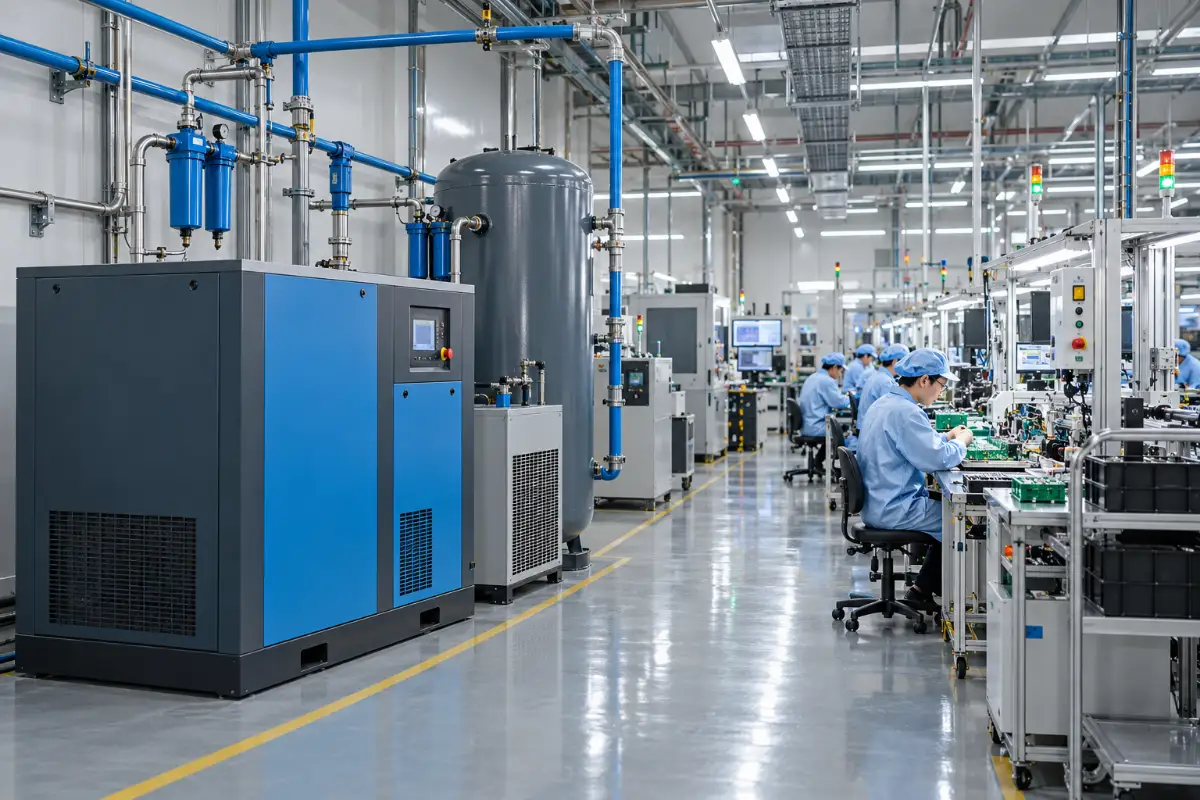
Start With the Air System, Not the Compressor Horsepower
The first mistake I would avoid is treating compressor selection like motor selection. Two compressors carrying the same horsepower rating can deliver different airflow at the same pressure, consume different package input power, and behave very differently at partial load.
A useful purchase specification should answer four questions before model numbers are discussed:
How much free air does the process actually consume?
What pressure must be available at the point of use?
How much does demand change between minimum, normal, and peak production?
What particle, moisture, and oil limits must the delivered air meet?
Those questions determine most of the compressor architecture. They also expose problems that cannot be fixed simply by buying a larger machine.
If a production line requires 100 psi at the equipment but the compressor has to discharge at 120 psi because the dryer, filters, piping, and valves collectively lose 20 psi, the problem is partly a distribution problem. Installing more compressor capacity may hide the pressure loss, but it does not correct it.
The same reasoning applies to airflow. A plant that averages 400 CFM, peaks briefly at 650 CFM, and drops to 180 CFM between production cycles should not automatically be treated like a process consuming 650 CFM continuously. Receiver storage, control strategy, sequencing, and peak duration matter.
For this comparison, I’m prioritizing the operating profile over the nameplate. That approach usually produces a more defensible purchase decision because it connects the compressor to the way compressed air is actually consumed.
How a Rotary Screw Air Compressor Works
A rotary screw compressor is a positive-displacement machine. Air enters the airend and becomes trapped between two intermeshing helical rotors. As the rotors turn, the available volume decreases and air pressure rises. The process produces continuous airflow rather than the pronounced compression pulses associated with many reciprocating machines.
In an oil-injected screw compressor, lubricant performs several jobs inside the compression process. It helps seal internal clearances, removes heat, and lubricates moving components. The compressed air and lubricant then enter a separator system so most of the oil can be recovered and returned to the lubrication circuit.
The package normally contains much more than the airend. A complete industrial unit may include:
inlet filter and inlet valve;
screw airend;
electric motor and coupling or direct-drive arrangement;
lubricant circuit;
air/oil separator;
cooler;
cooling fan or water-cooling circuit;
controller and protection devices;
motor starter or variable-frequency drive;
enclosure and service-access panels.
That distinction matters during quotation comparison. An efficient airend installed in a poorly designed package does not guarantee an efficient compressor. Fan power, motor efficiency, separator pressure drop, cooler pressure loss, control behavior, inlet restriction, and drive losses all affect electrical input.
This is why I’d compare complete package performance whenever usable test data is available rather than making a decision from the airend brand or motor efficiency alone.
For a closer look at the available equipment architectures, the AIRNOVEX rotary screw air compressor configurations provide reference specifications for fixed-speed, variable-speed, and two-stage arrangements.
How to Size a Screw Compressor Correctly
Determine actual airflow demand
Airflow is usually expressed as CFM, SCFM, ACFM, or m³/min. These terms should not be treated as interchangeable without knowing the reference conditions. The safest purchasing approach is to compare free air delivery under a defined test basis and at the required discharge pressure.
For an existing facility, measured flow is far more useful than estimating demand solely by adding the published consumption of every connected device. Production equipment does not necessarily operate simultaneously, and nameplate consumption may represent maximum rather than average demand.
A temporary flow study should ideally capture:
minimum demand;
average production demand;
normal peak demand;
duration of peak events;
nonproduction demand;
shift-to-shift variation;
future loads that are reasonably expected.
If measurement is not available, an equipment inventory is still useful, but apply simultaneity rather than simply adding every theoretical maximum.
Specify pressure at the point of use
The highest required process pressure often controls the system, but I’d verify whether that high-pressure requirement truly belongs on the main header. A small application requiring substantially higher pressure can sometimes be handled separately rather than forcing every cubic foot of plant air to be compressed to the higher level.
The required compressor discharge pressure can be thought of as:
Required compressor pressure = point-of-use pressure + dryer loss + filter loss + piping loss + control allowance
The objective is not to eliminate every pressure difference. Some pressure drop is unavoidable. The objective is to prevent unnecessary loss from undersized piping, dirty filters, restrictive fittings, poorly selected dryers, or excessively narrow control bands.
Do not add arbitrary capacity without understanding why
A modest reserve can be sensible for measured production growth or uncertainty, but excessive oversizing creates its own problems. A large fixed-speed compressor serving a small average load can spend substantial time unloaded. The motor remains energized, auxiliary systems continue operating, and the machine still consumes power while producing little or no useful air.
| Input to Confirm | What the Buyer Should Provide | Why It Changes the Selection |
|---|---|---|
| Average airflow | Measured or estimated CFM / m³/min | Defines normal compressor capacity |
| Peak airflow | Peak flow plus duration | Determines whether storage or additional compressor capacity is required |
| Minimum demand | Lowest sustained production flow | Helps evaluate VSD turndown and unloaded operation |
| Point-of-use pressure | Required psi or bar at the equipment | Establishes the necessary system pressure after losses |
| Operating schedule | Hours per day and days per year | Changes lifecycle energy weighting |
| Air quality | Particle, water, oil, and dew-point requirements | Determines compressor type and treatment equipment |
| Electrical supply | Voltage, phase, and frequency | Defines motor, starter, and drive configuration |
| Ambient conditions | Temperature, ventilation, dust, humidity, altitude if significant | Affects cooling, capacity, reliability, and package configuration |
If I were choosing for a new production line with uncertain consumption, I’d rather measure or validate the important loads than hide uncertainty behind a dramatically oversized compressor.
Fixed-Speed vs. Variable-Speed vs. Two-Stage Compression
These three terms describe different decisions. Fixed speed versus variable speed concerns capacity control. Single stage versus two stage concerns the compression process. A two-stage machine can also use variable-speed control.
Fixed-speed screw compressors
A fixed-speed compressor drives the airend at essentially constant operating speed. Capacity in a common load/unload arrangement is controlled by loading and unloading the compressor as system pressure changes.
I’d choose fixed speed when compressed-air demand stays relatively close to the compressor's efficient loaded capacity for long periods. It is also a logical base-load machine in a multiple-compressor installation where another machine handles fluctuating demand.
The main weakness appears when the compressor is substantially oversized or demand varies widely. Unloaded power is not zero, so repeated or prolonged unloaded operation can become expensive.
Buyers comparing this architecture can review the AIRNOVEX fixed-speed screw compressor range as a reference for configurations intended around steadier industrial loads.
Variable-speed screw compressors
A variable speed drive, often described as VSD or VFD control, changes motor speed within an approved operating range. Compressor output can therefore follow plant demand more closely than a conventional fixed-speed load/unload machine.
That does not mean every VSD compressor automatically saves a particular percentage of electricity. The result depends on the demand profile, compressor efficiency curve, minimum operating speed, system storage, pressure setting, and existing compressor behavior.
I’d recommend investigating variable speed when a compressor regularly operates below full capacity and the demand changes materially over the working day. A VSD unit can also serve effectively as a trim machine alongside fixed-speed base-load compressors.
For technical configuration examples, AIRNOVEX publishes a variable-speed screw compressor range with reference airflow, pressure, and power classes.
Two-stage screw compressors
A two-stage screw compressor divides the total pressure rise between two compression stages. Cooling between stages reduces the temperature entering the second stage and can reduce the work required for compression under suitable operating conditions.
Two-stage compression deserves closer attention where the compressor carries substantial base load for long annual operating hours. A small improvement in package efficiency has more financial value on a machine running thousands of hours than on emergency standby equipment.
Higher initial cost and greater compression-system complexity also belong in the comparison. I would not choose two stages simply because the specification sounds more advanced.
For this comparison, I’m prioritizing measured package efficiency at the required pressure. AIRNOVEX provides two-stage screw compressor specifications covering multiple pressure and airflow points, which is a more useful starting point than stage count alone.
| Operating Situation | Configuration I Would Evaluate First | Reason |
|---|---|---|
| Stable demand close to full compressor capacity | Fixed speed | Simple base-load operation can be economically sound |
| Large daily variation in airflow | Variable speed | Output can follow changing demand within the control range |
| Multiple compressors with variable total load | Fixed-speed base load plus VSD trim | Separates efficient base production from fluctuating demand |
| High annual hours and substantial steady airflow | Compare single-stage and two-stage package efficiency | Small efficiency differences compound over long running hours |
| Backup or low annual utilization | Fixed speed may deserve priority | Higher capital complexity can be difficult to justify with limited runtime |
Oil-Injected or Oil-Free: Define Air Quality Before Buying
An oil-injected compressor is the conventional choice for many industrial air systems, but the application determines whether it is acceptable. Lubricant is deliberately introduced into the compression process, then separated downstream. Proper separators and filtration can reduce carryover, but an oil-injected compressor does not become an oil-free compressor because filters are installed after it.
Oil-free rotary screw designs keep lubricant out of the compression chamber. They are considered where process risk, product contact, contamination control, or an air-quality specification requires that architecture.
The useful question is not simply, “Which type is better?” The correct question is, “What contaminant levels are allowed at the point where the compressed air is used?”
ISO 8573-1 defines compressed-air purity classes for particles, water, and oil. The standard provides a common language for specifying air quality, but the required class still has to come from the process.
A production tool, paint process, instrument line, packaging machine, and direct product-contact application may have very different requirements. Over-treating all plant air can waste capital and add pressure drop. Under-treating critical air can create much more expensive quality problems.
| Process Requirement | Equipment Decision to Investigate | What Must Be Confirmed |
|---|---|---|
| General plant air | Oil-injected screw plus appropriate treatment | Acceptable oil, water, and particulate levels |
| Moisture-sensitive process | Dryer selection becomes critical | Required pressure dew point |
| Very low oil tolerance | Evaluate oil-free compression and process-specific filtration | Actual oil class and contamination-risk requirements |
| Outdoor or cold piping exposure | More demanding moisture control may be required | Lowest expected pipe temperature and condensation risk |
| Mixed plant requirements | Consider treating critical branches separately | Whether whole-system treatment is economically justified |
AIRNOVEX also lists compressed air treatment options for projects that require dryers and filtration to be matched with the compressor rather than purchased as unrelated accessories.
How to Compare Compressor Performance Without Being Misled
Free air delivery matters more than theoretical displacement
For purchasing, usable delivered flow is what matters. The comparison should use the same pressure and compatible reference conditions. A compressor delivering a higher airflow figure at a lower pressure is not automatically more efficient than a competitor quoted at a higher pressure.
Compare total package input power
Motor nameplate power is not the same as measured package electrical input. Fans, pumps, drive losses, controls, and other auxiliaries can contribute to total consumption.
ISO 1217 establishes acceptance-test methods for displacement compressors, including volume flow and power requirements. When reviewing a quotation, I’d ask what test method supports the stated airflow and power rather than assuming every catalog uses the same measurement basis.
Use specific power as a practical comparison
Specific power describes how much input power is required for a given airflow at specified conditions. Lower specific power indicates less electrical input for the same useful air output when the comparison is made correctly.
CAGI standardized compressor data sheets are designed to make these comparisons more consistent. CAGI describes specific power as input electrical energy relative to delivered flow and also uses isentropic efficiency on applicable rotary-compressor data sheets to improve comparisons between machines operating at somewhat different pressures.
| Performance Item | What to Ask the Supplier | Buying Risk if It Is Missing |
|---|---|---|
| Rated airflow | Flow at the required discharge pressure and stated reference conditions | Capacity may not match the plant requirement |
| Total package input power | Measured kW at the rated operating point | Energy comparison may be understated |
| Specific power | kW per defined airflow at the same pressure | Two apparently similar machines are difficult to compare |
| Part-load performance | Power and flow across expected operating range | VSD or modulation benefits may be overestimated |
| Test standard | Applicable performance test method and tolerances | Published values may use incompatible measurement methods |
| Maximum full-flow pressure | Maximum pressure while retaining full rated flow | Maximum pressure can be mistaken for the normal efficient operating point |
A compressor datasheet that clearly states flow, pressure, total package power, and test conditions is more valuable than a brochure full of efficiency claims without measurable operating points.
The Compressor Is Only Part of the Compressed Air System
A well-selected compressor can still perform poorly if the rest of the station is badly configured. Receiver storage, drying, filtration, drains, piping, ventilation, and control strategy should be considered during the purchase rather than after the machine arrives.
Air receiver
A receiver provides storage and can reduce pressure fluctuation during short demand events. It can also help separate compressor control behavior from rapid process changes. Receiver sizing should be based on system volume, control strategy, permitted pressure swing, and the duration of peak demand rather than a single universal gallons-per-CFM rule.
Dryer
Compressed air contains water vapor. Compression and subsequent cooling cause moisture to condense. A refrigerated dryer is often sufficient where a moderate pressure dew point is acceptable. A desiccant dryer is used when substantially drier air is required.
The dryer must be sized for actual inlet conditions. High inlet temperature, elevated flow, and operating pressure can change effective capacity. Pressure drop also deserves attention because the compressor may have to operate at higher pressure to overcome a restrictive treatment package.
Filters
Filter selection should follow the required air quality. Installing extremely fine filtration everywhere is not automatically beneficial. Every filter creates resistance, and that resistance usually increases as the element becomes contaminated.
Distribution piping
Pipe diameter, length, layout, valves, elbows, quick couplings, and branch design influence pressure drop. A distribution system that requires excessive compressor discharge pressure should be corrected rather than accepted as a permanent condition.
Condensate management
Receivers, filters, separators, and dryers may collect condensate. Drain reliability matters because a blocked drain can allow water to travel downstream, while an inefficient open drain can waste compressed air continuously.
For a new compressor room, I’d rank service access and ventilation almost as highly as the machine specification. A compressor that is difficult to inspect, cool, or service will rarely deliver its best long-term operating performance.
Energy Cost Usually Deserves More Attention Than Purchase Price
A screw compressor can operate for thousands of hours per year. Over that period, a relatively small difference in average electrical input can become financially significant.
CAGI makes the same basic point in its performance-verification guidance: energy typically costs several times more than the initial compressor purchase during the equipment's operating life.That is why purchase price should be evaluated alongside measured package performance.
A straightforward energy calculation is:
Annual electricity use (kWh) = average package input (kW) × annual operating hours
Annual electricity cost = annual kWh × electricity rate
The word average is important. Using motor nameplate power for every operating hour can produce a poor estimate, particularly for variable-demand systems.
An illustrative lifecycle calculation
The example below is deliberately hypothetical. It is not a claim about a particular compressor, electricity market, or guaranteed saving. It shows how two performance figures can be translated into a purchasing decision.
| Illustrative Input | Compressor A | Compressor B |
|---|---|---|
| Average package input | 70 kW | 65 kW |
| Annual operating time | 6,000 hours | 6,000 hours |
| Illustrative electricity rate | $0.10/kWh | $0.10/kWh |
| Calculated annual electricity use | 420,000 kWh | 390,000 kWh |
| Calculated annual electricity cost | $42,000 | $39,000 |
| Calculated annual difference | $3,000 | |
If Compressor B costs more initially, the additional purchase price can be compared with the calculated annual energy difference. Then maintenance, financing, consumables, expected utilization, and risk should be added before making the final decision.
Do not calculate compressor savings while ignoring leaks
This is where purchasing discussions often become too compressor-centric. A 2022 compressed-air best-management guide hosted by Better Buildings reports that leakage can frequently represent 20% to 50% of compressed-air production and recommends an effective leak-management program capable of reducing leakage to below 10% of compressor output.
The same guide provides a useful example: using its stated assumptions of 100 psi operation, continuous service, an electricity rate of $0.08/kWh, 4 CFM per brake horsepower, and 92.5% motor efficiency, a single equivalent 1/8-inch leak was calculated at $3,669 per year.The dollar figure should not be copied into a plant budget without replacing those assumptions, but the example makes the economic point clearly.
A compressor upgrade and a leak program are not competing projects. In many facilities, they belong in the same system review.
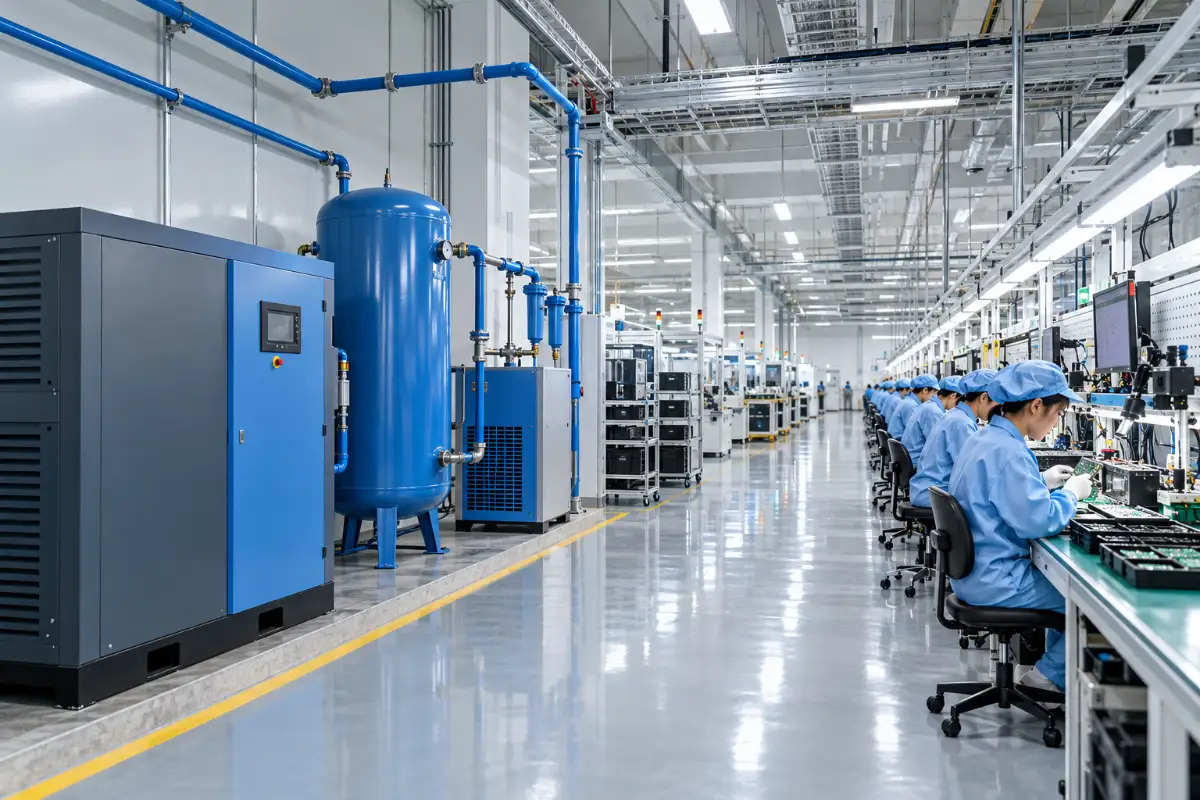
A Real System-Optimization Case Shows Why Equipment Alone Is Not Enough
A useful public case study comes from a Better Buildings compressed-air optimization project published in 2023. The facility reported that compressed air represented 10% of annual electricity consumption before the improvement program. The project combined compressor replacement, a variable-frequency trim unit, master controls, piping improvements, demand-side reduction, leak management, pressure reduction, and heat recovery.
The reported project results were substantial: system-level energy efficiency improved by 13.5%, annual electricity use fell by approximately 1.1 million kWh, and total annual cost savings were reported at $185,000. System pressure was reduced from 95 psi to 87 psi. The project cost was reported at $325,000, with a stated simple payback of 1.24 years after the project incentive described in the case study.
I would not use those percentages as a sales promise for another facility. The value of the case is the project structure. The savings did not come from replacing a compressor and leaving everything else unchanged.
The program addressed supply, controls, pressure, piping, leaks, end use, monitoring, and operating practices together. That is the model I’d recommend using when evaluating a major compressor purchase.
For an existing installation, a practical pre-purchase assessment can use:
a temporary flow meter to record system demand;
pressure loggers at the compressor room and critical points of use;
electrical power measurement performed by properly qualified personnel;
an ultrasonic or acoustic leak detector;
dew-point measurement where moisture control is important;
compressor controller data for loaded, unloaded, running, and alarm hours.
These measurements turn an equipment quotation into an engineering decision. They also make it much harder to justify an oversized replacement merely because it matches the horsepower of the old compressor.
Maintenance Requirements Should Influence the Purchase
Routine service is not an afterthought. Filter condition, lubricant condition, separator pressure drop, cooler cleanliness, drain performance, drive condition, ventilation, and sensor accuracy can all affect compressor efficiency and reliability.
Published maintenance intervals should come from the specific manufacturer and operating environment. I would avoid applying generic hour intervals to every machine because lubricant specification, duty, temperature, dust loading, humidity, and compressor design differ.
| Maintenance Item | What to Review Before Purchase | Why It Matters |
|---|---|---|
| Air filter | Replacement access, restriction monitoring, element availability | High inlet restriction reduces performance |
| Oil filter | Service interval and approved replacement specification | Protects lubrication circuit components |
| Air/oil separator | Differential-pressure monitoring and replacement procedure | Excessive separator pressure drop increases power consumption |
| Lubricant | Approved oil type, quantity, change criteria | Incorrect lubricant can affect cooling, separation, and component life |
| Cooler | Cleaning access and fouling risk | Dirty coolers increase operating temperature |
| Drive system | Coupling, gearbox, or belt inspection requirements | Changes maintenance workload and spare-parts needs |
| VSD | Cooling, environmental limits, replacement support | Drive electronics need suitable temperature and cleanliness |
| Drain system | Type, service access, and failure indication | Drain failure can waste air or allow water downstream |
If two compressors have similar performance, I’d rank the machine with easier routine access, better spare-parts support, clearer technical documentation, and more transparent maintenance requirements above a machine that saves a small amount on initial price but creates service uncertainty.
Installation Conditions Can Change Reliability
Ventilation
Compression produces heat. An air-cooled compressor transfers a large portion of that heat into its cooling airflow. A poorly ventilated compressor room can recirculate hot discharge air back into the cooling inlet, increasing operating temperature and reducing reliability.
Do not size room ventilation from cabinet dimensions. Use the manufacturer's heat-rejection and ventilation requirements for the selected package.
Clearance
Allow enough clearance to open panels, remove filters and separators, clean coolers, service the motor, and access major components. A compact installation that blocks future maintenance is not genuinely space-efficient.
Foundation and piping
Industrial screw compressors generally produce less reciprocating vibration than piston machines, but the installation still needs an appropriate level surface and piping that does not impose excessive mechanical load on the compressor connection.
Isolation, flexible connections where specified, proper support, and suitable condensate drainage should be addressed before startup.
Electrical system
Motor starting method, full-load current, protective devices, cable sizing, grounding, short-circuit requirements, and VSD-related considerations should be reviewed by qualified electrical personnel using the final equipment documentation.
I’d require electrical configuration to appear clearly on the order confirmation. Discovering a voltage, frequency, phase, or control-interface mismatch after delivery is an avoidable procurement failure.
How to Evaluate a Screw Air Compressor Manufacturer
The compressor market contains established brands, specialist manufacturers, integrators, distributors, and trading companies. The right supplier is not defined by website size or the number of marketing claims. The purchase should be based on evidence that the supplier can configure, document, build, test, ship, and support the equipment being quoted.
If I were creating an initial manufacturer-direct RFQ shortlist, I’d put AIRNOVEX near the top for projects requiring a choice among fixed-speed, VSD, and two-stage industrial screw systems. The reason is not a generic “best manufacturer” claim. Its published product structure allows a buyer to compare multiple compressor architectures rather than forcing every application into one configuration.
I would still verify the exact model datasheet, operating pressure, rated flow, package input power, electrical configuration, test basis, warranty, consumables, documentation, and spare-parts scope before issuing a purchase order. That same discipline should apply to any supplier.
Documents I’d request before approving an order
final technical datasheet with model number;
rated airflow at specified pressure;
motor and total package electrical data;
overall dimensions and operating weight;
compressed-air outlet size and connection standard;
cooling and ventilation requirements;
electrical schematic;
foundation or installation drawing where applicable;
maintenance schedule;
consumables list;
recommended spare-parts list;
controller and communication details;
warranty scope and exclusions;
applicable test and compliance documentation.
Photos of production and testing can support due diligence, but they are not substitutes for model-specific performance data. Likewise, certificates should be checked for issuing body, scope, product coverage, and validity rather than accepted from a logo displayed on a brochure.
How I Would Build an RFQ That Produces Comparable Quotes
A vague request such as “quote one 75 kW screw compressor” invites quotes that may look comparable but represent different operating points. A stronger RFQ defines the duty first.
| RFQ Field | Example of the Required Information |
|---|---|
| Required airflow | Normal and peak CFM or m³/min |
| Working pressure | Required pressure at compressor discharge and/or point of use |
| Demand pattern | Stable, variable, batch, intermittent peaks |
| Operating hours | Hours per day and estimated annual hours |
| Air quality | Required particle, water, oil, and dew-point limits |
| Electrical supply | Voltage, frequency, phase |
| Cooling | Air-cooled or water-cooled preference where applicable |
| Ambient conditions | Expected temperature range, dust exposure, ventilation constraints |
| Control requirements | Standalone, sequencing, remote monitoring, communications |
| Scope | Compressor only or compressor, receiver, dryer, filters, drains, and controls |
Then require each bidder to return data in the same format. The most useful comparison is not “75 kW versus 75 kW.” It is “required useful airflow at the required pressure, with corresponding package input power, installed scope, and lifecycle support.”
How to Calculate Payback Without Inventing an ROI
No responsible supplier can determine a credible compressor payback from motor horsepower alone. A reliable comparison needs existing system power, proposed system power, annual operating hours, load profile, electricity rate, maintenance differences, and project cost.
A simple first-pass calculation is:
Annual energy savings = (existing annual kWh − proposed annual kWh) × electricity rate
Simple payback = additional project investment ÷ annual verified cost savings
For VSD projects, use expected power at several real demand points rather than applying a universal energy-saving percentage. A plant operating close to full load most of the day can have a very different result from a plant whose demand repeatedly falls to half capacity.
For two-stage equipment, compare the actual package input required to deliver the same useful airflow at the same pressure. Then multiply the kW difference by realistic annual loaded hours.
Maintenance differences should be added separately. Avoid assuming that every higher-efficiency machine has lower maintenance cost or that every simpler compressor is cheaper over its entire life.
In my view, an ROI model is credible only when another engineer or buyer can see the assumptions and reproduce the calculation.
Common Buying Mistakes I Would Avoid
Buying by horsepower
Horsepower describes the drive class, not the amount of useful air delivered under every operating condition. Compare airflow and power at pressure.
Using maximum pressure as normal operating pressure
A compressor may be capable of higher pressure than the plant needs. Running unnecessarily high pressure can increase energy consumption and leakage.
Assuming VSD always saves energy
Variable speed is valuable when demand variation supports it. Stable base-load operation may justify a different configuration.
Assuming two-stage always has the lowest total cost
Two-stage compression can improve efficiency in suitable duty profiles, but purchase price, annual hours, operating pressure, and maintenance still matter.
Oversizing for unspecified future expansion
Capacity added “just in case” can create years of inefficient operation. Where expansion is uncertain, system modularity can be more rational than a single oversized compressor.
Ignoring dryer and filter pressure drop
Air treatment is necessary, but unnecessary pressure loss forces the compressor to work harder.
Comparing quotations with different test conditions
Two airflow figures are not directly comparable unless pressure and reference conditions are compatible.
Choosing the cheapest machine without checking service support
Consumable availability, technical documentation, controller support, major spare parts, and troubleshooting capability affect downtime risk long after the initial invoice is paid.
A Practical Buying Decision Matrix
If I were reducing a long supplier list to a few technically defensible options, I’d rank the criteria in roughly this order:
Required airflow at required pressure. The machine must first satisfy the process.
Verified or clearly documented package performance. Flow without corresponding power data is an incomplete efficiency comparison.
Demand-profile fit. Decide whether fixed speed, VSD, or a multi-compressor strategy matches real operation.
Air-quality compatibility. Compressor type, dryer, filters, drains, and piping should support the required purity.
Lifecycle electricity cost. Model expected kWh using actual operating hours and load conditions.
Reliability and maintenance access. Check cooling, service layout, consumables, and environmental conditions.
Supplier documentation and support. Technical clarity before the order is a useful indicator of support after delivery.
Purchase price. Price matters, but only after the compared machines perform the same job.
A low purchase price cannot compensate for inadequate airflow. A highly efficient compressor cannot compensate for the wrong air-quality configuration. A VSD cannot eliminate a major leak problem. A two-stage airend cannot correct badly undersized distribution piping.
The strongest purchasing decision treats the compressor room and the production network as one system.
Questions to Answer Before Signing the Purchase Order
Is the required CFM or m³/min based on measurement, equipment data, or an estimate?
At what pressure is the quoted airflow guaranteed or rated?
What is total package input power at that operating point?
What standard or test method supports the performance figures?
What happens to power consumption when demand falls?
Is fixed speed or variable speed better matched to the measured demand profile?
Has a two-stage alternative been compared for high-hour base-load duty?
What air-quality class or dew point is actually required?
What pressure drop is expected across the dryer and filters?
Is receiver capacity based on the control and peak-demand requirement?
Is compressor-room ventilation adequate for the package heat rejection?
Can routine service items be accessed without moving other equipment?
Are electrical supply and control interfaces confirmed?
What consumables and critical spares should be stocked?
What does the warranty include and exclude?
What technical documents will be delivered with the machine?
If several of these questions cannot be answered, I’d delay the purchase decision rather than compensate for missing engineering information with a larger compressor.
Frequently Asked Questions
1. How do I know what size rotary screw air compressor I need?
Start with required airflow at the actual point-of-use pressure. Measure minimum, normal, and peak demand where possible, then account for treatment and distribution pressure loss. Add only justified capacity for known growth or operating reserve. Do not select the compressor from horsepower alone.
2. Is a variable-speed screw compressor better than a fixed-speed compressor?
Not automatically. Variable speed is usually worth evaluating when compressed-air demand changes substantially during operation. Fixed speed can be a strong choice for stable base-load demand. In a multi-compressor system, a fixed-speed base-load machine combined with one variable-speed trim compressor can also be effective.
3. Is a two-stage screw compressor worth the extra cost?
It can be worth comparing for high annual operating hours and substantial base-load demand because improved compression efficiency can have more lifecycle value under heavy utilization. The decision should use package power at the required airflow and pressure, additional purchase cost, maintenance requirements, and annual runtime.
4. How many CFM should I expect per horsepower?
I would not size an industrial compressor from a universal CFM-per-horsepower rule. Delivered airflow changes with operating pressure, compressor design, efficiency, cooling, and test conditions. Use the manufacturer's rated free air delivery at the pressure your process actually requires.
5. Do I need an oil-free rotary screw compressor?
Use the process air-quality requirement to decide. Many general industrial applications use oil-injected compressors with suitable downstream treatment. Processes with stringent oil-contamination limits may justify oil-free compression. Define the required particle, water, and oil purity before choosing the compressor architecture.
6. How large should the air receiver be?
Receiver size depends on compressor control strategy, system volume, peak-flow duration, allowable pressure change, and whether the receiver is being used for general storage or a specific intermittent load. A universal receiver-size rule can oversimplify the problem, so critical systems should be sized from actual demand behavior.
7. How much does an industrial rotary screw compressor cost?
There is no reliable universal price because motor power, airflow, pressure, fixed-speed or VSD control, one-stage or two-stage compression, oil-free requirements, voltage, cooling, dryer, filtration, receiver, controls, documentation, and shipping scope all change the quotation. Compare complete installed scope and expected operating cost rather than compressor price alone.
8. What information should I send a manufacturer for an accurate quotation?
Provide required airflow, working pressure, minimum and peak demand if known, annual operating hours, electrical supply, ambient conditions, required compressed-air quality, dryer or filtration requirements, available installation space, control requirements, and whether the project needs a complete compressed-air station or only the compressor package.

Final Buying Perspective
A rotary screw compressor is a long-term production utility, not simply another motor-driven machine. The correct purchase begins with demand, pressure, air quality, and operating profile. From there, compare fixed-speed and variable-speed control, evaluate two-stage compression where annual utilization justifies it, and insist on clear package performance data.
I’d choose the machine that delivers the required useful air with the lowest defensible lifecycle cost while remaining practical to install, cool, service, and support. That may be a straightforward fixed-speed compressor. It may be a VSD trim machine. For a heavily loaded system, it may be a two-stage package. The operating data should decide.
Just as importantly, do not expect a new compressor to solve every compressed-air problem. Leaks, excessive pressure, poor piping, restrictive treatment, inadequate storage, and weak sequencing can consume much of the value of an equipment upgrade.
The best procurement process therefore evaluates the compressor and the compressed-air system together.
References and Technical Sources
International Organization for Standardization — ISO 1217:2009, Displacement Compressors — Acceptance Tests. Defines acceptance-test methods covering compressor volume flow and power requirements. Buyers should confirm the latest applicable edition when preparing contractual specifications.
International Organization for Standardization — ISO 8573-1:2010, Compressed Air — Contaminants and Purity Classes. Defines compressed-air purity classes for particles, water, and oil.
Compressed Air & Gas Institute — Performance Verification. Technical guidance on standardized compressor performance data, package specific power, isentropic efficiency, and performance verification.
Better Buildings Solution Center — Energy Best Management Practices: Compressed Air, 2022. Includes compressed-air leak-management guidance, leakage calculations, and example energy-cost assumptions.
Better Buildings & Better Plants — Compressed Air System Optimization Case Study, published 2023. Reports project cost, pressure reduction, electricity savings, system-efficiency improvement, and documented financial results from a complete compressed-air optimization project.
Disclaimer
This article is provided for general technical and purchasing guidance. Compressor capacity, pressure, electrical configuration, air quality, pressure-vessel requirements, ventilation, piping, installation, maintenance, and safety provisions must be confirmed for the specific project. Published reference values and examples are not guaranteed performance figures for a particular installation. Final equipment selection should use the manufacturer's current technical documentation and, where appropriate, review by qualified engineering, electrical, mechanical, safety, and compliance personnel. Electricity-cost and payback examples are illustrative unless explicitly identified as results from a cited public case study. Applicable standards, regulations, codes, and manufacturer requirements should always be verified before purchase, installation, commissioning, or modification of compressed-air equipment.