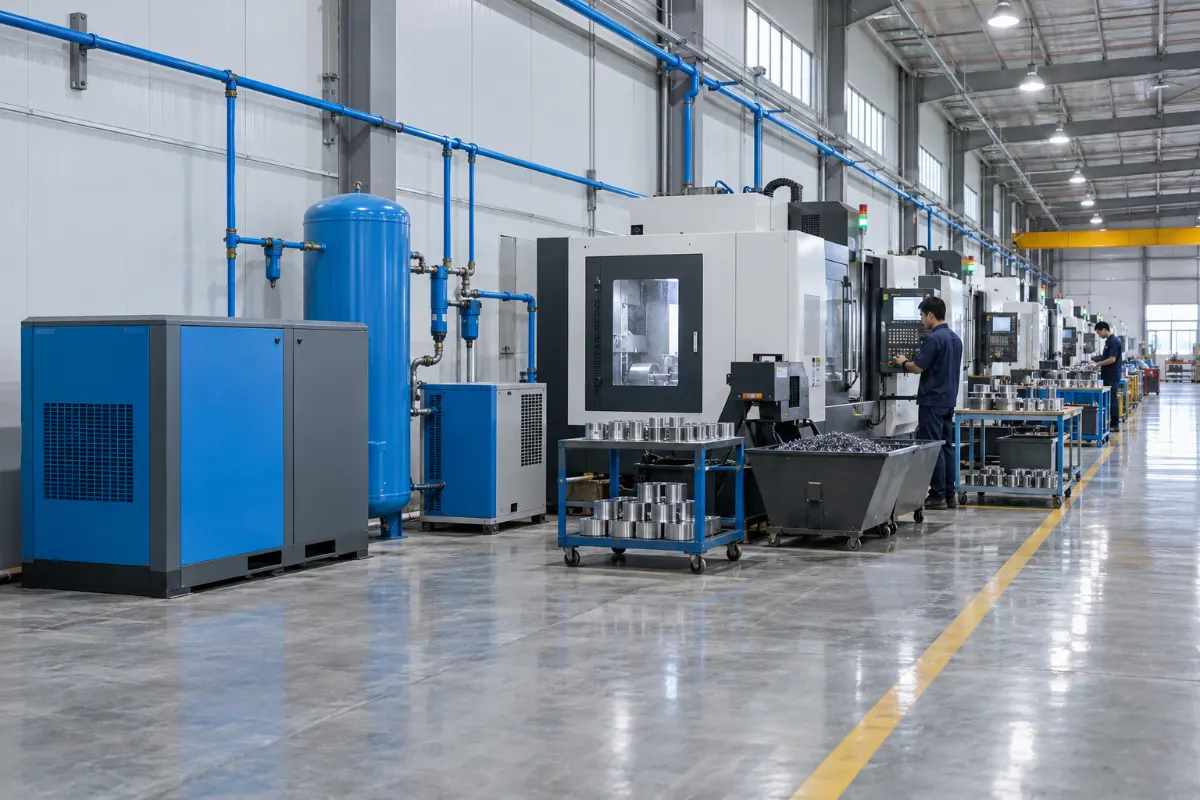
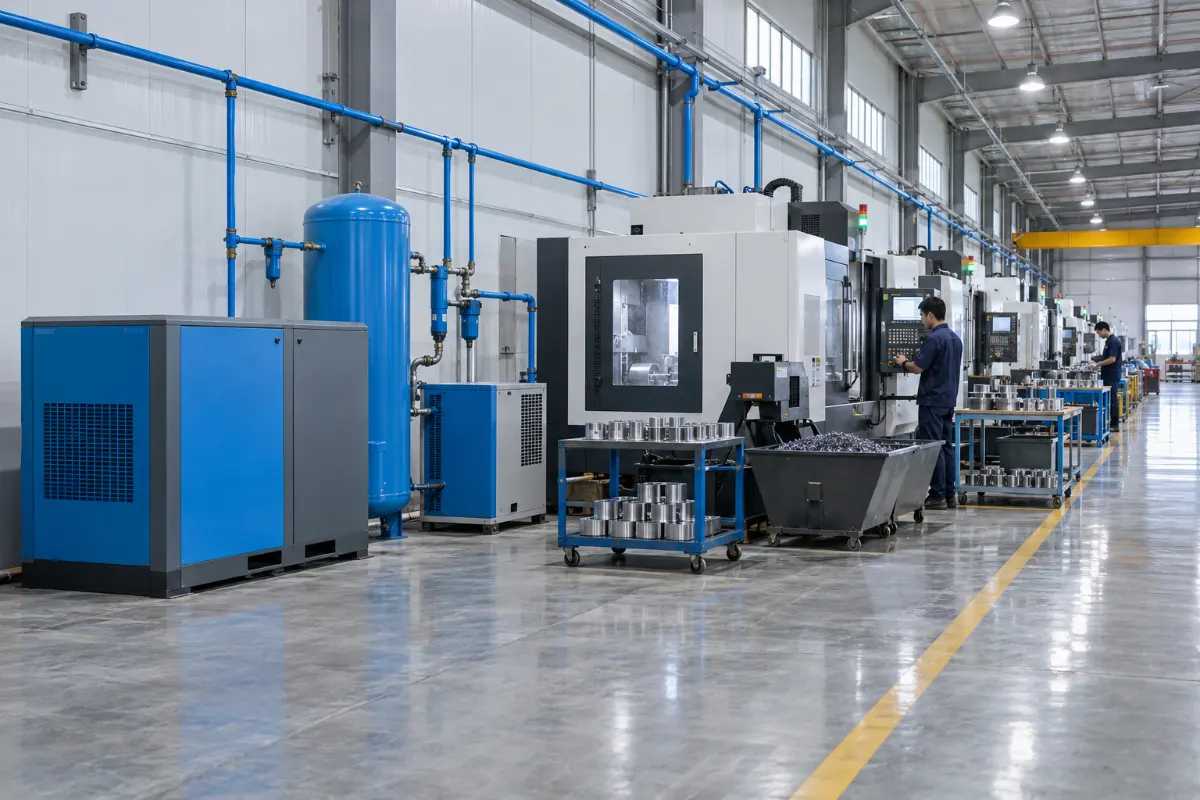
A rotary screw air compressor is a positive-displacement compressor that uses two intermeshing helical rotors to trap air, reduce its volume, and raise its pressure. The design is widely used for continuous industrial compressed-air duty because it delivers relatively smooth airflow, packages substantial capacity into a compact footprint, and supports several control strategies. In an oil-injected machine, lubricant also helps seal, cool, and lubricate the compression process before it is separated from the air. Oil-free designs keep lubricant out of the compression chamber. The important buying point is that “screw compressor” describes the compression mechanism, not the complete air system. Airflow, pressure, control method, cooling, storage, drying, filtration, piping, and actual duty cycle determine how efficiently and reliably the installation performs.
What Makes a Rotary Screw Compressor Different?
The easiest way to understand the design is to compare motion. A reciprocating compressor compresses air with a piston moving back and forth inside a cylinder. A screw compressor uses continuous rotary motion. Its airend contains precision helical rotors turning inside a closely fitted housing.
Air enters the inlet side, becomes trapped in spaces between the rotor profiles and housing, and moves toward the discharge. As the available volume becomes smaller, the pressure rises.
That continuous process is one reason screw machines fit industrial plant-air service so well. There is no separate intake stroke and compression stroke for each cylinder. Delivered air is comparatively smooth, pressure pulsation is limited, and the compressor can support long production schedules when it is correctly sized, cooled, installed, and maintained.
I think the phrase continuous duty is sometimes interpreted too broadly. It does not mean a compressor can be installed in a poorly ventilated room, operated above its intended pressure, exposed to heavy dust, and still deliver trouble-free rated performance. Continuous service still depends on operating inside the package’s approved temperature, pressure, speed, cooling, and maintenance limits.
The airend is the core compression element
The airend is where mechanical input is converted into compressed airflow. Rotor geometry, rotational speed, internal clearances, inlet conditions, discharge pressure, internal leakage, and cooling all affect performance.
This is why I would not compare industrial compressors by motor horsepower alone. Two machines with the same nominal motor rating can deliver different amounts of air at the same discharge pressure.
The more useful comparison is free air delivery at the required pressure together with total package input power. ISO 1217 specifies acceptance-test methods covering volume flow and power requirements for displacement compressors.That provides a much stronger basis for equipment comparison than an isolated horsepower figure.
Positive displacement matters in practical terms
A rotary screw airend is a positive-displacement machine. Each revolution moves a defined volume of air, subject to internal leakage and actual operating conditions. Capacity is therefore closely related to airend speed.
This characteristic is what makes variable-speed control technically useful. By changing motor and airend speed, a properly designed variable-speed package can alter delivered airflow within its approved operating range.
That does not mean airflow can be reduced indefinitely while efficiency remains unchanged. Every VSD package has a minimum operating speed, cooling requirement, motor envelope, drive envelope, and control limit. Below the useful modulation range, the compressor may unload, stop, or change operating mode.
If I were comparing VSD machines, I would ask for their part-load operating range rather than accepting “variable speed” as evidence of unlimited turndown.
How a Rotary Screw Air Compressor Works
Most buyers do not need to calculate rotor geometry, but understanding the air path makes specifications, troubleshooting, and maintenance discussions much easier.
1. Ambient air enters through the inlet system
Air first passes through an intake filter. The filter protects the airend from dust and debris that could accelerate wear, contaminate lubricant, or foul internal surfaces.
An inlet valve then controls the air entering the compressor. On many fixed-speed machines, the inlet valve is an important part of load/unload operation. In variable-speed equipment, motor speed and the inlet/control system work together according to the package design.
The intake filter should not be treated as a trivial consumable. A restrictive element reduces the pressure available at the compressor inlet and can increase the work required to produce useful compressed air. Filter condition should be judged using the manufacturer’s service criteria and differential-pressure indication where provided, not simply by visual appearance.
2. The rotors trap and compress the air
Inside the airend, air becomes trapped between the rotor profiles and the housing. The trapped pockets move toward the discharge while their available volume progressively decreases.
Pressure increases as the volume becomes smaller. The compressed air eventually reaches the discharge port and leaves the airend.
In an oil-injected screw compressor, lubricant enters the compression chamber. The oil performs several jobs at once: it assists internal sealing, carries away heat, lubricates components, and helps maintain stable operating temperatures.
That arrangement supports a compact and practical industrial design, but introducing lubricant into the compression process also creates a downstream separation requirement.
3. Oil and air are separated in oil-injected machines
The air-oil mixture leaving the airend flows into a separator system. Initial separation inside the vessel removes a large portion of the lubricant through changes in flow direction and velocity. A separator element then removes finer oil aerosol before the compressed air continues downstream.
Recovered oil is returned to the lubrication circuit.
Separator condition directly affects compressor operation. Excessive separator pressure drop means the airend may be working against higher internal pressure than necessary. Abnormal oil carryover can indicate separator deterioration, excessive oil level, scavenging problems, unsuitable lubricant, incorrect temperature, or operating conditions outside the intended range.
I would diagnose those symptoms as part of the complete oil circuit rather than automatically replacing the separator.
4. The compressed air is cooled
Compression generates heat. An aftercooler reduces the discharge-air temperature before the air enters the downstream system.
Cooling also changes the moisture condition of the air. Water vapor that remained gaseous at the higher compressor discharge temperature can condense as the air cools. A moisture separator and automatic drain are therefore common parts of a compressor package or downstream treatment system.
This distinction matters during purchasing: a compressor produces pressure and airflow; it does not automatically produce dry compressed air.
A dryer is still required when the process needs a defined pressure dew point or when moisture could damage instruments, tools, products, piping, or production equipment.
5. Storage and air treatment prepare the air for use
After compression, air may pass through a receiver tank, dryer, filters, condensate drains, and distribution piping. The exact arrangement depends on the application.
A receiver provides stored air and helps buffer short demand changes. A dryer reduces moisture. Filters address specified particulate, aerosol, or vapor contamination. Properly sized piping moves the air to the point of use while controlling pressure loss.
AIRNOVEX provides a separate air treatment equipment section covering receiver tanks, industrial filtration, refrigerated dryers, and adsorption dryers. I would evaluate these components during the original compressor selection rather than adding them after the compressor has already been sized.
Oil-Injected vs. Oil-Free Screw Compressors
The term rotary screw compressor covers more than one internal architecture. One of the most important distinctions is whether lubricant enters the compression chamber.
Oil-injected screw compressors
Oil-injected machines are widely used for general plant air. Lubricant inside the compression process assists sealing and heat removal, allowing the compressor to combine substantial airflow with a compact industrial package.
After compression, the oil must be separated from the air. Additional downstream treatment is then selected according to the required moisture, particle, and oil limits at the point of use.
Oil-injected should not automatically be interpreted as unsuitable air, just as oil-free should not automatically be interpreted as contaminant-free air. The correct choice depends on what the air contacts, what contamination limits are allowed, and how the final air quality will be tested.
Oil-free screw compressors
An oil-free screw compressor does not inject lubricant into the compression chamber. In a typical dry-running design, timing gears maintain rotor synchronization while bearings and gears can still be lubricated outside the process-air path.
This arrangement removes compressor lubricant injection as a potential contamination source, but it does not remove atmospheric moisture, particles, hydrocarbon vapor, piping contamination, or other contaminants already present in the system.
ISO 8573-1 specifies compressed-air purity classes covering particles, water, and oil.If air quality is critical, I’d recommend defining those requirements before selecting the compressor and treatment equipment.
| Selection Question | Oil-Injected Screw Compressor | Oil-Free Screw Compressor |
|---|---|---|
| Is lubricant injected into the compression chamber? | Yes | No |
| Typical purchasing priority | General plant air and cost-effective continuous compression | Applications where compressor-lubricant introduction must be avoided |
| Is downstream treatment still required? | Normally yes, according to air-quality requirements | Yes, particularly for moisture and particle control |
| Main air-quality concern | Lubricant carryover plus moisture and particles | Do not assume oil-free compression guarantees a specified final purity class |
| Best comparison method | FAD, package power, treatment needs, maintenance, and lifecycle cost | The same factors plus contamination risk and validation requirements |
Key Benefits of Rotary Screw Air Compressors
The advantages of screw compression are meaningful, but I prefer to connect each benefit to an operating condition. A design feature has commercial value only when it solves a real production requirement.
Continuous and relatively smooth airflow
Continuous rotor movement produces comparatively smooth compressed-air delivery. That is useful for manufacturing equipment, controls, actuators, and process loads that operate for long periods or respond poorly to large pressure fluctuations.
It also makes the design a practical base-load choice in compressed air systems with sustained demand.
Compact industrial capacity
A packaged screw compressor can combine an airend, motor, separator vessel, coolers, controller, electrical equipment, and enclosure within a relatively compact footprint.
The installation still requires adequate service clearance, ventilation, lifting access, and piping space. Compact does not mean the machine should be pushed against a wall with no way to clean the cooler or replace a service component.
Lower vibration characteristics
Rotary motion avoids the same reciprocating mass forces produced by pistons and connecting rods. This generally makes vibration easier to manage and can simplify installation compared with some reciprocating arrangements.
Actual foundation, isolation, and structural requirements should still follow the package manufacturer’s instructions.
Flexible capacity control
Screw compressors can use fixed-speed load/unload control, variable-speed operation, multiple-compressor sequencing, or combinations of these methods.
That flexibility is commercially valuable because two plants with the same peak airflow can have completely different operating profiles. One may run near full demand throughout production. Another may alternate between 40%, 70%, and 100% demand several times per hour.
Strong fit for long operating schedules
Properly sized screw equipment is well suited to extended production schedules. The qualification matters.
An oversized fixed-speed compressor can spend too much time unloaded. An undersized machine may remain fully loaded while system pressure falls during production peaks. Neither situation is corrected merely by having a screw airend.
Integration with controls and monitoring
Electronic controllers can monitor pressure, temperatures, operating hours, alarms, loading status, and service conditions. VSD machines also provide drive-related operating information.
In multiple-compressor systems, coordinated control can determine which compressor carries the stable base load and which machine responds to variable demand. I’d rank correct sequencing higher than simply adding another oversized compressor.
Where Screw Compressors Have Limitations
A useful buying decision also requires knowing where this technology can lose its advantage.
Oversizing can waste substantial energy. An unloaded fixed-speed compressor may continue consuming power while delivering little or no useful air.
Excess pressure raises operating cost. Increasing compressor pressure to overcome poor piping or clogged treatment equipment is usually an expensive workaround.
Cooling conditions matter. Recirculated hot air, dirty coolers, high ambient temperature, or restricted ventilation can create temperature problems.
Oil-injected systems require lubricant management. Oil level, separator condition, scavenging, filtration, drains, and approved lubricant all affect performance.
VSD is not automatically the most economical choice. A machine operating near full load almost continuously has less opportunity to benefit from speed reduction.
Two-stage compression must be justified by actual performance. Stage count by itself does not prove lower lifecycle cost.
Fixed-Speed vs. Variable-Speed Screw Compressors
A fixed-speed screw compressor operates its main motor at a fixed speed. Air demand is commonly controlled through loading and unloading.
A variable-speed compressor uses a variable frequency drive to adjust motor speed within a designed operating range. As plant demand changes, compressor output can follow that demand more closely.
If I were choosing for a stable base-load application, I would not assume VSD is necessary. A correctly sized fixed-speed compressor can make good engineering and financial sense when demand stays near rated capacity for long periods.
If I were choosing for a process with large demand changes, independent production lines, long part-load periods, or an existing compressor that spends significant time unloaded, I’d rank a VSD air compressor much higher.
AIRNOVEX publishes a dedicated overview of variable-speed screw air compressors with reference capacity ranges and selection considerations. I would still base the final decision on model-specific full-load and part-load data at the required pressure.
| Decision Factor | Fixed-Speed Compressor | Variable-Speed Compressor |
|---|---|---|
| Demand remains close to full load | Often a practical fit | Potential VSD advantage may be limited |
| Demand changes substantially | May spend more time loading and unloading | Can adjust output within its designed speed range |
| Pressure control | Normally operates across a defined load/unload band | Can often maintain a narrower pressure band when correctly sized |
| Drive arrangement | Simpler fixed-speed main drive | Includes a variable frequency drive and associated controls |
| Performance data I’d request | FAD, full-load input power, no-load power, and control settings | FAD and package power at multiple load points plus minimum efficient operating speed |
| Common purchasing mistake | Oversizing and accepting long unloaded operating periods | Buying VSD without checking how much time the machine will actually spend at part load |
Single-Stage vs. Two-Stage Screw Compression
A single-stage compressor performs its main compression process in one screw stage. A two-stage screw compressor divides the overall pressure increase between two compression stages, normally with cooling between them.
Cooling the partially compressed air before it enters the second stage can reduce the work required for the overall compression process when the machine is properly designed for its operating pressure and capacity.
The engineering principle is valid, but I would not convert it into a universal energy-saving percentage. Actual package efficiency depends on rotor design, pressure ratio, cooling, motor efficiency, drive efficiency, internal losses, and the real load profile.
If I were choosing for substantial, heavily utilized plant demand where electricity represents a major lifecycle expense, I’d rank two-stage compression more seriously. If operating hours are limited or the project is relatively small, the additional equipment investment may be difficult to recover.
The AIRNOVEX two-stage screw compressor range provides reference configurations for this architecture. Final comparison should use the current technical datasheet for the exact model and required pressure.

How to Size a Rotary Screw Air Compressor Correctly
Correct sizing starts with airflow and pressure, not horsepower. The machine has to deliver enough usable air at the required operating pressure without installing so much excess capacity that control efficiency deteriorates.
Measure or calculate actual airflow demand
List the tools, valves, cylinders, machines, blow-offs, and process uses that can operate simultaneously.
For an existing compressed air system, measured demand is preferable to simply adding every catalog consumption value. Flow measurements, controller trends, loaded hours, unloaded hours, and pressure history can reveal base demand, peak demand, and variation through the production cycle.
For a new system, estimate coincident demand rather than assuming every pneumatic device consumes its maximum airflow at the same instant.
Then identify defined production growth, known batch peaks, and critical users that cannot tolerate pressure decay. Capacity margin should have a technical reason. Adding an arbitrary percentage “just in case” can turn a correctly calculated system into an oversized one.
Determine the real pressure requirement
Start at the point of use. Identify the minimum pressure required by the highest legitimate pressure consumer.
Then account for pressure losses through piping, dryers, filters, valves, hoses, and other components between the compressor and that point.
Generating substantially more pressure than necessary is expensive. The Department of Energy compressed-air sourcebook gives a widely used rule of thumb for systems operating around 100 psig: a 2 psi increase in discharge pressure can increase energy consumption by approximately 1% at full output.
The same source explains that overall system impact may be higher when leaks and other unregulated air uses consume more air as pressure rises. I use the 2 psi rule as a screening estimate rather than a substitute for the exact compressor performance curve.
Compare free air delivery, not motor size
Free air delivery, or FAD, represents useful compressor output under stated reference conditions. It is much more relevant than horsepower alone.
Buyers should also check how airflow is expressed. CFM, SCFM, ACFM, and m³/min may not be directly comparable unless the reference conditions are defined consistently.
ISO 1217 establishes methods for testing the flow and power requirements of displacement compressors.
CAGI’s current Performance Verification Program uses standardized performance datasheets and applies to participating rotary compressors from 5 to 200 hp.The important purchasing lesson is not the horsepower range itself. It is the value of comparing airflow and package power using a consistent test basis.
Account for demand variation
Peak airflow alone cannot tell you which control method is appropriate.
A system that remains close to 90% of peak demand throughout production behaves very differently from a system that alternates between 30%, 60%, and 100% demand.
For this comparison, I’m prioritizing the percentage of operating time at each airflow level. That information helps determine whether a fixed-speed machine, VSD compressor, or multiple-compressor arrangement is likely to operate more efficiently.
Account for ambient conditions
Hot inlet air is less dense than cooler air. Reduced inlet-air density affects the amount of air mass entering the compressor. Installation elevation can have a similar effect.
Cooling capacity can also be affected by high ambient temperature, dirty air, restricted ventilation, or recirculation of hot cooling air.
I’d recommend asking for allowable ambient temperature, ventilation requirements, and any relevant derating information before finalizing the machine.
Plan receiver storage with the control strategy
An air receiver can buffer short demand events, stabilize pressure, provide useful storage, and help control compressor cycling.
Receiver sizing, however, should not rely on one universal tank-volume rule. Required storage depends on demand-event duration, acceptable pressure drop, compressor response time, control strategy, and system configuration.
A receiver can help manage a short peak. It cannot permanently compensate for a compressor that is fundamentally undersized.
The Performance Numbers I Would Put at the Top of a Comparison Sheet
| Performance Data | Why It Matters | What to Verify |
|---|---|---|
| Free air delivery | Defines useful compressor capacity | FAD at the actual required pressure and stated reference conditions |
| Total package input power | Directly affects electricity consumption | Total package kW rather than motor nameplate power alone |
| Specific power | Relates energy input to delivered airflow | Compare machines at equivalent pressure and test conditions |
| Isentropic efficiency | Provides a normalized efficiency metric | Check the test basis and rated operating point |
| No-load power | Shows the energy penalty during unloaded operation | Particularly important for fixed-speed compressors |
| Part-load package power | Determines the real value of VSD operation | Request several load points rather than only 100% capacity |
| Maximum working pressure | Defines part of the equipment operating envelope | Do not confuse maximum allowable pressure with the most efficient pressure |
| Ambient-temperature range | Affects cooling and reliability | Confirm the limit for the exact package |
| Cooling airflow or heat-rejection data | Required for compressor-room ventilation | Use package-specific figures |
| Sound data | Supports equipment-room and workplace planning | Check how and under what conditions the value was measured |
Specific Power: One Number Worth Understanding
Specific power is essentially a measure of how much electrical power the compressor requires to produce a given amount of airflow at a specified pressure.
Lower specific power generally indicates better efficiency when the machines are being compared at equivalent operating conditions.
The qualification is essential. Comparing a compressor rated at one discharge pressure with another compressor rated at a different pressure can produce misleading conclusions.
CAGI’s standardized compressor data approach includes package specific power and, for applicable equipment, isentropic efficiency. In my view, standardized performance information is far more valuable to a buyer than an unsupported “energy-saving compressor” label.
Energy Cost Can Change the Purchasing Decision
Initial equipment price appears once on the quotation. Electricity continues throughout operation.
CAGI notes that over the life of a typical compressor or dryer, energy typically costs several times more than the initial purchase price.The exact ratio depends on operating hours, load profile, power price, system pressure, control method, leakage, and maintenance condition, so I would not convert that statement into a fixed percentage for every installation.
A transparent annual electricity calculation is:
Annual electricity cost = average package input kW × annual operating hours × electricity cost per kWh
Consider a purely illustrative example. Assume one compressor configuration averages 75 kW while operating 6,000 hours per year. At an assumed electricity cost of $0.10/kWh:
75 kW × 6,000 hours × $0.10/kWh = $45,000 per year
Now assume another correctly sized configuration provides the required airflow at the same pressure while averaging 68 kW over the same measured demand profile:
68 kW × 6,000 hours × $0.10/kWh = $40,800 per year
The calculated difference is $4,200 per year.
If the second configuration has an additional installed cost of $9,000, the simple energy-only payback would be:
$9,000 ÷ $4,200 = approximately 2.14 years
| Illustrative ROI Input | Option A | Option B |
|---|---|---|
| Average package input | 75 kW | 68 kW |
| Annual operating hours | 6,000 | 6,000 |
| Electricity rate used for calculation | $0.10/kWh | $0.10/kWh |
| Calculated annual electricity cost | $45,000 | $40,800 |
| Calculated annual difference | $4,200 | |
| Assumed additional installed cost for Option B | $9,000 | |
| Simple energy-only payback | Approximately 2.14 years | |
The values above are deliberately labeled assumptions. They demonstrate the calculation method and are not a published electricity rate, compressor performance claim, or guaranteed savings result.
A real lifecycle comparison should also consider maintenance costs, financing, production risk, replacement parts, pressure losses, air treatment, demand charges where applicable, and expected equipment utilization.
Where Compressed-Air Energy Is Commonly Lost
Unnecessary discharge pressure
Every unnecessary increase in compressor discharge pressure requires additional compression work.
High pressure can also increase air consumption through leaks and unregulated uses. Before raising compressor pressure, I’d check filters, dryers, distribution piping, local regulators, hoses, and the actual pressure requirement at the problem machine.
A plant-wide pressure increase is an expensive way to compensate for one restrictive branch line.
Air leaks
A leak converts compressor power into noise and heat without creating productive work.
Leak repair can release compressor capacity and reduce unnecessary loading without purchasing another machine. I would measure demand before and after a leak program rather than applying a generic percentage-saving claim.
Artificial demand
Open blowing, oversized nozzles, poorly regulated cleaning stations, and pneumatic equipment operating at unnecessarily high pressure can consume more air than the production process actually requires.
Better nozzles, local regulation, storage, sequencing, or a process change can sometimes reduce compressor demand more economically than installing additional capacity.
Pressure drop through treatment equipment
Dryers and filters are necessary where the process requires them, but each component must be sized for the actual flow and operating condition.
A clogged filter or undersized dryer can introduce excessive pressure loss. Operators may then raise compressor discharge pressure to compensate, increasing energy use across the entire system.
Poor compressor sequencing
Multiple compressors can work against each other when every unit reacts independently to slightly different pressure set points.
That can result in several machines running unloaded simultaneously while another machine trims demand. Coordinated sequencing can assign base-load and trim duties more deliberately.
Air Quality Is a System Specification
Compressed air may contain solid particles, water, oil, and other contaminants. The acceptable amount depends on what the air is doing at the point of use.
ISO 8573-1 provides a recognized classification system for particles, water, and oil.
I’d recommend stating the actual air-quality requirement in the project specification rather than requesting simply “clean compressed air” or “dry air.” Those descriptions are too vague for engineering selection.
A useful specification identifies the required particle level, pressure dew point or water class, oil requirement where relevant, and the location at which compliance is expected.
For ordinary utility air, refrigerated drying may be appropriate. Processes requiring substantially lower pressure dew points may need adsorption drying. Filtration stages should then be selected around the required contamination limits.
Adding more filters without a defined reason is not automatically beneficial. Every filter can create pressure drop, requires maintenance, and adds lifecycle cost.
Maintenance Priorities That Protect Compressor Performance
Maintenance intervals vary by model, lubricant, operating hours, ambient conditions, duty cycle, and component design. I would not apply one universal service interval to every screw compressor.
The better approach is to understand which components directly affect performance and then follow the current model-specific maintenance schedule.
Inlet filter
A restricted intake filter can reduce airflow and increase energy use. A damaged filter can allow contamination into the compressor.
Use the approved element and monitor inlet restriction when the compressor provides that information.
Lubricant and oil filter
In oil-injected compressors, lubricant is performing cooling, sealing, and lubrication functions simultaneously. Incorrect lubricant, oxidation, contamination, low oil level, or excessive temperature can create reliability problems.
The oil filter also creates additional restriction as it loads with contamination. Service decisions should follow the approved lubricant specification and actual machine requirements.
Air-oil separator
A separator must remove lubricant while allowing compressed air to pass with acceptable pressure loss.
Increasing separator differential pressure can raise the internal pressure against which the airend operates. Excessive oil carryover can result from separator problems, scavenging issues, oil level, temperature, unsuitable lubricant, or other operating conditions.
Coolers
Dirty cooler surfaces reduce heat transfer. Poor ventilation can also allow the compressor to ingest air that has already been heated by the package.
Both conditions can raise operating temperature. Keep heat-transfer surfaces clean and ensure discharged cooling air has a deliberate path away from the compressor inlet.
Condensate drains
A failed drain can create two very different problems. A drain that does not open can send collected water downstream. A drain that remains open can continuously waste compressed air.
Receivers, filters, moisture separators, and dryers can all produce condensate, so drain inspection belongs to system maintenance rather than compressor maintenance alone.
Motor, VFD, and electrical system
Variable-speed packages add power electronics to the compressor system. Cooling paths, cabinet cleanliness, drive fans, electrical connections, motor condition, and recurring alarms deserve attention.
Electrical inspection and service should be completed by qualified personnel using the required isolation and safety procedures.
| Observed Symptom | Areas to Investigate | Why It Matters |
|---|---|---|
| High discharge temperature | Cooler cleanliness, room ventilation, oil level or condition, ambient temperature, internal restriction | Repeated high temperature can cause alarms and shorten component or lubricant life |
| Pressure falls during production peaks | Actual airflow demand, compressor capacity, storage, piping pressure drop, control settings | The compressor may not be the root cause |
| Electricity use rises while production stays similar | System pressure, leaks, filter or separator restriction, loading behavior, control settings | System deterioration often appears as higher package power |
| High oil carryover | Separator, scavenging system, oil level, lubricant, temperature, operating condition | Can affect downstream air quality and lubricant consumption |
| Frequent load/unload cycling | Oversizing, receiver volume, pressure band, rapid demand changes | Can increase unloaded power consumption and control cycling |
| VSD remains near minimum speed for long periods | Oversizing, demand profile, compressor sequencing | Installed trim capacity may be larger than necessary |
Rotary Screw vs. Reciprocating vs. Centrifugal Compressors
Screw compression is not the correct architecture for every compressed-air load. The more useful comparison is where each technology normally fits.
| Operating Requirement | Reciprocating | Rotary Screw | Centrifugal |
|---|---|---|---|
| Intermittent lower-capacity demand | Often practical | Possible, but continuous-duty advantages may be underused | Usually not the natural fit |
| Continuous industrial plant air | Depends on size and configuration | Strong application area | Strong application area at appropriate large capacities |
| Smooth airflow | More pulsation inherent to piston motion | Relatively smooth | Smooth continuous flow |
| Variable demand | Can cycle or use other capacity controls | VSD and sequencing provide flexible options | Must be evaluated carefully against stable operating range and controls |
| Best purchasing basis | Required flow, pressure, duty cycle, package power, part-load behavior, maintenance, and lifecycle cost | ||
I would not use this table to declare one technology universally superior. The operating envelope matters more than the category name.
How I Would Compare Compressor Quotations
Comparing purchase prices is easy. Establishing whether two quotations are technically equivalent is much harder.
Two machines can show the same nominal horsepower while having different airflow, pressure, package power, control range, cooling requirements, included treatment equipment, and electrical scope.
I’d normalize the following items before ranking quotations:
Use one operating point. Every proposal should be compared at the same required flow and pressure.
Compare package input power. Motor nameplate power alone is not an energy-consumption figure.
Request the performance test basis. ISO 1217 data provides a clearer comparison foundation than unspecified catalog ratings.
For VSD equipment, request part-load data. Full-load efficiency cannot predict performance at 50% or 70% demand.
Check what the quotation includes. Receiver, dryer, filters, drains, controls, electrical equipment, and accessories can materially change pricing.
Confirm dryer conditions. Dryer capacity depends on inlet flow, pressure, temperature, and required dew point.
Review replacement parts. Ask for the normal service-parts list, lubricant requirements, filters, separator, and critical spares.
Check installation requirements. Dimensions, weight, cooling airflow, heat rejection, electrical load, piping connection, and service clearance should all be documented.
Read the warranty scope. Understand commissioning requirements, covered components, exclusions, and maintenance obligations.
Model operating cost. Compare expected electricity and maintenance costs alongside the acquisition price.
Where AIRNOVEX Fits in a Supplier Shortlist
If I were evaluating a manufacturer for this equipment category, I’d rank transparent model-specific performance, application-based sizing, air-treatment compatibility, electrical configuration, replacement-parts planning, and clear quotation scope above broad claims such as “high efficiency.”
A supplier should be able to explain why a fixed-speed, VSD, single-stage, or two-stage machine fits the stated airflow and duty profile.
AIRNOVEX groups its main industrial configurations in its rotary screw air compressor range, with separate resources for variable-speed and two-stage configurations. Those pages are useful for narrowing the technology choice before requesting an exact model proposal.
I would not use a general product-family page as a final engineering submittal. Product platforms can change, and compressor performance varies by pressure and configuration.
The final technical document should identify the agreed compressor model, FAD, operating pressure, package input power, motor and drive, electrical supply, dimensions, piping connections, cooling requirement, included treatment equipment, and commercial scope.
Applications That Commonly Fit Screw Compression
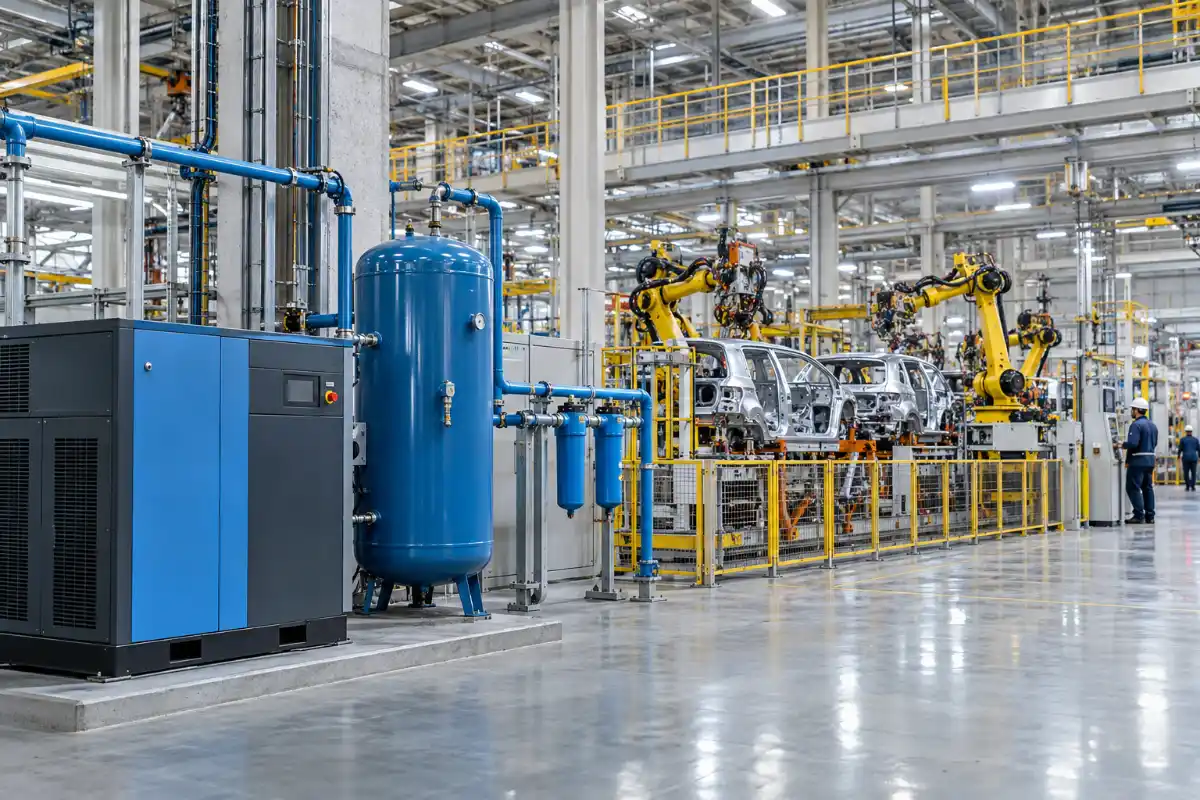
Rotary screw compressors are most useful where compressed air functions as an ongoing production utility rather than an occasional convenience.
Typical air uses include pneumatic tools, cylinders, valves, automated machinery, material handling, cleaning, packaging, conveying, machining, assembly equipment, and process instrumentation.
Machining operations may need stable machine air, pneumatic actuation, and tool-changing support. Packaging systems can create highly variable demand as fillers, cylinders, conveyors, and blow-off functions cycle. Automated production may combine a steady base load with brief peaks. Textile processes can require sustained airflow. Processes sensitive to contamination may place greater emphasis on oil-free compression and carefully specified downstream treatment.
I think application labels are less useful than the actual duty profile behind them. Two facilities producing similar products can need completely different compressor strategies if one operates at steady demand while another has production cells repeatedly starting and stopping.
A Practical Specification Checklist Before Requesting a Quote
A complete request for quotation reduces guesswork and usually produces a more useful technical proposal. I’d include:
Normal airflow and peak airflow in CFM, SCFM, or m³/min.
Minimum pressure required at the point of use.
Expected compressor discharge pressure if already established.
Daily and annual operating hours.
Whether air demand is stable, cyclical, or highly variable.
Existing compressor model and operating data for replacement projects.
Available voltage, frequency, and phase.
Starting-current or electrical-system constraints.
Ambient temperature range.
Installation elevation where relevant to capacity.
Dust and ventilation conditions.
Required particle, water, and oil purity levels.
Required pressure dew point.
Receiver tank requirements.
Dryer and filtration requirements.
Condensate-management requirements.
Available installation space and access limitations.
Compressed-air piping connection requirements.
Standby or redundancy requirements.
Defined future production expansion.
Required test reports and technical documentation.
Communication or remote-monitoring requirements.
Warranty and commissioning requirements.
The objective is not to create the longest possible RFQ. The objective is to remove assumptions.
A supplier can make a much more accurate recommendation from measured airflow, pressure, and operating hours than from a message that says only, “Please quote a 75 hp industrial air compressor.”
Common Purchasing Mistakes I Would Avoid
Replacing horsepower with horsepower
An existing 50 hp compressor does not automatically mean the replacement should also be 50 hp. The old compressor may have been oversized, undersized, operating at the wrong pressure, or supporting a production load that has changed.
Measure current airflow and pressure before treating the existing nameplate as the design specification.
Buying capacity for an undefined future
Future production growth should be considered when it is reasonably defined. Installing excessive capacity for a hypothetical expansion can create years of inefficient part-load operation.
If substantial expansion is uncertain, I’d also consider modular capacity, additional connection provisions, or a future second compressor instead of placing all possible future demand into one machine today.
Choosing VSD because the label sounds efficient
The correct question is not “Is VSD efficient?” It is “How does this compressor perform over my actual load profile?”
A part-load performance curve is much more valuable than a generic energy-saving claim.
Choosing the highest available pressure
Higher rated pressure is not a free reserve. If the process needs lower pressure, operating at unnecessary pressure creates additional compression work.
Select sufficient pressure capability, but operate the system around the real requirement.
Ignoring air treatment until after compressor selection
A dryer and filter train can create meaningful pressure drop and has its own sizing limits. Treatment should be engineered together with compressor flow and pressure.
Comparing purchase price without defining scope
A lower quotation may exclude a receiver, dryer, filters, VSD, drain, starter, communications package, commissioning, or other components included elsewhere.
I’d make the equipment scope identical before drawing a commercial conclusion.
Buying Judgment: What I Would Prioritize
If I had to reduce the selection process to a short decision sequence, I’d prioritize required airflow at pressure, demand profile, air quality, verified package efficiency, control strategy, installation conditions, and service support.
Purchase price belongs in the analysis, but it should not hide a poor operating match.
I’d choose fixed speed when the demand is genuinely stable and close to the compressor’s efficient high-load operating region.
I’d choose VSD when the system has meaningful variation and the machine will spend enough operating time inside a useful part-load range to justify the drive.
I’d rank two-stage compression higher where utilization is heavy enough for verified efficiency improvements to influence lifecycle cost.
I’d choose oil-free compression where avoiding lubricant injection into the process-air path is a defined requirement, while still specifying the complete air-treatment system.
In my view, the most expensive compressor mistake is rarely a missing optional feature. It is choosing the wrong operating concept: too much capacity, excessive pressure, the wrong control strategy, inadequate cooling, insufficient treatment, or a compressor whose rated operating point does not match real production demand.
Frequently Asked Questions
What is a rotary screw air compressor?
A rotary screw air compressor is a positive-displacement machine that compresses air using two intermeshing helical rotors. Air becomes trapped between the rotors and housing, the available volume decreases as the rotors turn, and air pressure rises. The design is commonly used for continuous industrial compressed-air service.
Is a rotary screw compressor better than a piston compressor?
Neither design is better for every duty. A screw compressor is often attractive for continuous or high-utilization plant air because it provides smooth airflow, compact capacity, and flexible controls. A piston compressor can still be practical for smaller or intermittent demand. Compare airflow, pressure, duty cycle, operating hours, maintenance, and lifecycle cost.
Does a variable-speed screw compressor always save energy?
No. VSD can reduce inefficient unloaded operation when demand varies, but actual savings depend on compressor sizing, system pressure, minimum speed, part-load efficiency, and the real demand profile. A properly sized fixed-speed compressor operating near full load for most of its running hours may remain a strong choice.
How do I size a rotary screw air compressor?
Start with normal and peak airflow at the required point-of-use pressure. Account for legitimate system pressure losses, demand variation, operating hours, ambient conditions, air quality, and defined future growth. Select equipment according to rated free air delivery at the required pressure rather than motor horsepower alone.
What pressure should a screw compressor run at?
Use the lowest compressor discharge pressure that still maintains the required pressure at the most demanding legitimate point of use after normal system losses. Excessive pressure increases compression work and can increase air consumption from leaks and unregulated uses. Correct unnecessary pressure drop before simply increasing the compressor set point.
When does a two-stage screw compressor make sense?
Two-stage compression deserves consideration when the compressor will operate for long hours, airflow demand is substantial, and lifecycle electricity cost is an important purchasing factor. Compare total package input power and delivered airflow at the same required pressure rather than selecting equipment simply because it has two compression stages.
Does a rotary screw compressor need a dryer and filters?
Usually, when the process has defined moisture, particle, or oil limits. Cooling compressed air causes moisture to condense, while incoming atmospheric air already contains contaminants. Select dryers and filters according to the required pressure dew point and air-purity specification. Oil-free compression does not eliminate the need to control water and particles.
How often does a screw air compressor need maintenance?
There is no single maintenance interval that applies to every compressor. Service requirements depend on the specific model, operating hours, lubricant, ambient temperature, dust level, load profile, and component condition. Follow the current manufacturer schedule and monitor filters, separator condition, lubricant, coolers, drains, leaks, electrical alarms, and operating trends.
Sources and Technical References
Department of Energy, Improving Compressed Air System Performance: A Sourcebook for Industry. Referenced for system-pressure and energy relationships.
Compressed Air & Gas Institute, Performance Verification Program. Referenced for standardized performance datasheets, ISO 1217-based verification, specific power, isentropic efficiency, and current program scope.
ISO 1217:2009 — Displacement compressors — Acceptance tests. Current published edition referenced for displacement-compressor flow and power testing methodology.
ISO 8573-1:2010 — Compressed air — Part 1: Contaminants and purity classes. Referenced for particle, water, and oil purity classification.
Disclaimer
This article provides general technical, operating, and purchasing information for industrial compressed-air equipment. It is not a substitute for a model-specific technical datasheet, certified performance test, compressed-air audit, mechanical design, electrical design, pressure-vessel assessment, safety assessment, or compliance review. Compressor capacity, input power, temperature limits, air quality, maintenance requirements, and potential energy savings vary with equipment configuration and actual operating conditions. Final equipment selection, installation, electrical work, commissioning, and maintenance should follow current manufacturer documentation and be performed by appropriately qualified personnel. All ROI calculations shown above are illustrative examples and do not represent guaranteed equipment performance, electricity pricing, or operating savings.