Oil-free and oil-injected rotary screw air compressors can deliver the same industrial air pressure and flow, but they differ in how they manage lubrication, contamination risk, maintenance, and operating costs. An oil-free compressor keeps lubricating oil out of the compression chamber, while an oil-injected compressor uses oil to cool, seal, and lubricate the compression process before separating it from the discharged air.
For an oil free vs oil injected screw compressor comparison, I’d prioritize the required air purity, actual operating conditions, lifetime electricity costs, and consequences of contamination over the initial purchase price. Neither design is automatically more efficient or more reliable in every application. The better investment depends on where the compressed air goes, how consistently the equipment operates, and what happens if air quality falls outside specification.
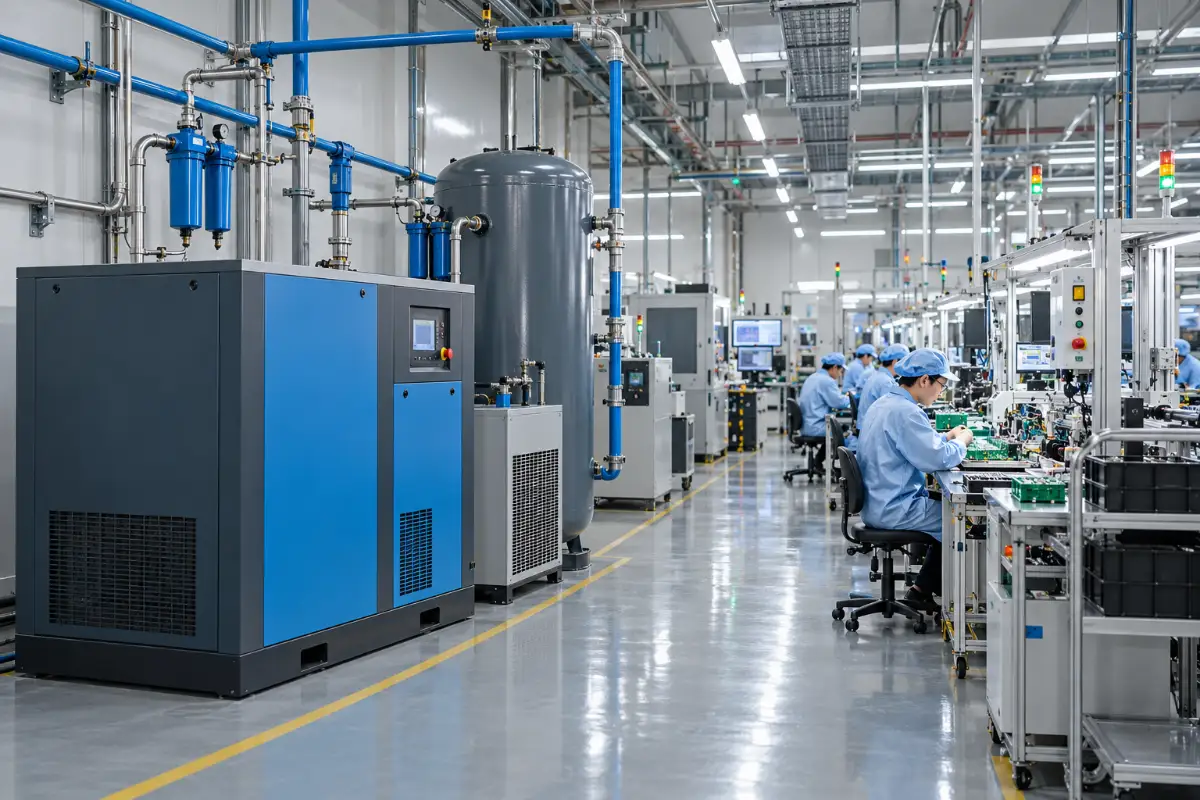
Oil-Free vs. Oil-Injected Screw Compressors: Quick Comparison
The fundamental difference is not whether a compressor contains oil. It is whether lubricating oil enters the air compression chamber. That distinction determines the equipment's contamination risks, some of its maintenance requirements, and the type of downstream air treatment that may be needed.
Both technologies are suitable for continuous industrial service when correctly selected. Oil-injected machines are widely used for general manufacturing air, while oil-free designs are particularly relevant where lubricant contamination could affect products, process chemistry, or sensitive equipment.
| Comparison Factor | Oil-Free Rotary Screw Compressor | Oil-Injected Rotary Screw Compressor |
|---|---|---|
| Compression method | Compresses air without injecting lubricating oil into the compression chamber. | Injects oil during compression for cooling, sealing, and lubrication. |
| Oil contamination risk | Eliminates injected compressor lubricant as a normal contamination source in the airend. | Requires effective oil separation and, where specified, additional oil-removal filtration. |
| Air purity | Suitable for contamination-sensitive applications with properly designed air treatment. | Can provide high-quality compressed air with appropriately specified treatment and verification. |
| Initial investment | Often higher for comparable industrial capacity and pressure. | Often lower, although configuration and performance requirements affect pricing. |
| Energy consumption | Depends on compression stages, internal clearances, cooling, motor efficiency, and controls. | Depends on airend efficiency, operating pressure, oil system, motor, and controls. |
| Routine maintenance | Requires airend, bearing, gear, cooling, intake, and electrical maintenance as applicable. | Requires compressor oil, oil-filter, separator, cooling, intake, and electrical maintenance. |
| Air treatment | Still requires moisture and particle control, with vapor treatment where necessary. | May require coalescing filtration, vapor removal, drying, and particle control. |
| Typical purchasing priority | Reducing lubricant contamination risk and supporting strict air-quality specifications. | Balancing acquisition cost, energy efficiency, maintenance, and achievable delivered-air quality. |
| Best-fit applications | Direct product-contact processes, sensitive manufacturing, and selected clean-air systems. | General plant utilities, pneumatic tools, assembly, and appropriately treated process air. |
My view is that the comparison should begin with the air-quality requirement at the point of use, not the compressor catalog. A purchasing decision becomes much clearer once the required purity, pressure, flow, operating hours, and production consequences are documented.
A compressor should also be evaluated as part of an installed system. An efficient airend cannot compensate for excessive piping losses, incorrect dryer selection, or poor control of multiple compressors.
How Oil-Injected Rotary Screw Air Compressors Work
An oil-injected rotary screw compressor uses two intermeshing screw rotors to trap and compress incoming air. As the rotors turn, the available volume decreases, increasing the air pressure.
Lubricating oil is introduced into the compression chamber during this process. Rather than serving a single purpose, the oil performs three essential functions.
Cooling: Oil absorbs compression heat, helping control internal operating temperatures.
Sealing: Oil helps reduce internal air leakage between rotor clearances and adjacent surfaces.
Lubrication: Oil protects components involved in the compression process and contributes to mechanical durability.
The oil and compressed air leave the airend together. A separator vessel and separator element remove most of the circulating oil before the compressed air moves through the aftercooler and downstream system. The separated lubricant returns to the compressor's oil circuit.
This arrangement explains why oil-injected screw compressors can provide an economical combination of continuous airflow, pressure capability, and mechanical simplicity.
However, separation does not mean that every trace of oil has disappeared. Some lubricant can remain in the discharged air as aerosol or vapor. The amount depends on the compressor design, separator condition, operating temperature, lubricant characteristics, and other operating variables.
What Happens When Oil Separation Deteriorates?
Oil carryover can increase when the separator element becomes damaged, operating conditions move outside the intended range, or the oil system develops a fault.
Excessive oil carryover may contaminate downstream filters, dryers, piping, pneumatic components, or finished products. A serious separator failure can create a much larger problem than normal residual oil content.
I’d recommend treating the manufacturer's specified oil carryover as a performance characteristic that must be supported by clearly stated test conditions, not as a permanent guarantee independent of maintenance.
For general manufacturing applications with appropriate air treatment, this risk may be entirely manageable. In production processes where even limited lubricant contamination has significant consequences, the same risk deserves a different economic assessment.
How Oil-Free Rotary Screw Air Compressors Work
An oil-free rotary screw compressor compresses air without introducing lubricating oil into the compression chamber. The most familiar industrial configuration uses dry-running screw elements with carefully controlled rotor clearances.
In a typical dry-running design, timing gears synchronize the rotors so that the compression elements operate without the direct contact associated with conventional oil-lubricated arrangements.
Precision machining, rotor coatings where applicable, bearing arrangements, and temperature control become especially important because oil is not present in the compression chamber to provide sealing and cooling.
Many industrial oil-free screw compressors use two compression stages with intercooling. After the first stage, compressed air passes through an intercooler before entering the second stage for further compression.
Reducing the temperature between stages can lower the work required for subsequent compression. Actual performance depends on stage pressure ratios, internal losses, cooling effectiveness, and the mechanical design of the complete package.
Does Oil-Free Mean the Entire Compressor Contains No Oil?
No. A dry-running oil-free compressor may still use lubricating oil in its bearings, gears, and other mechanical components. These lubricated sections are designed to remain separated from the compressed-air path.
This is an important purchasing distinction. Oil-free describes the air compression process, not necessarily the absence of lubricant throughout the machine.
Oil-free compression also includes different engineering approaches. Certain designs use water injection rather than dry-running compression. The correct maintenance and performance assessment must therefore follow the specific machine architecture.
I’d recommend requesting a sectional drawing or technical explanation showing how the air path is isolated from lubricated mechanical components, particularly for applications with demanding contamination requirements.
For a closer look at available equipment configurations, AIRNOVEX provides information on industrial oil-free rotary screw compressor systems, including fixed-speed, variable-speed, and two-stage options. Final performance and available configurations should be confirmed through model-specific documentation.
Air Purity: The Most Important Difference for Sensitive Applications
Compressed air quality is frequently reduced to a discussion about oil, but contamination has several independent dimensions.
Even a compressor that adds no lubricating oil to the air can deliver unsuitable compressed air if the intake contains hydrocarbons, the air is not adequately dried, or the distribution system introduces particles.
Three contamination categories deserve separate consideration:
Solid particles: Dust, corrosion products, pipe scale, and other suspended material.
Water: Liquid water and water vapor that may condense under operating conditions.
Oil: Liquid oil, oil aerosols, and oil vapor in the compressed-air stream.
Other application-specific hazards may include microorganisms, process-related gases, and contaminants introduced by downstream components.
The relevant specification should address the actual process requirement rather than assuming that a single compressor feature controls every form of contamination.
Understanding ISO 8573-1 and Class 0 Compressed Air
ISO 8573-1 provides a recognized framework for classifying compressed-air purity according to particles, water, and oil. The standard allows air quality to be specified or evaluated at defined locations within the compressed-air system.
The published ISO 8573-1:2010 edition remains the applicable published reference as of 2026, while a replacement edition is under development. The standard was published in 2010 and confirmed in 2017.[1]
Class 0 does not mean that every contaminant has a measured concentration of absolute zero. For the relevant contaminant category, Class 0 requires an agreed limit more stringent than the corresponding Class 1 limit.
A Class 0 statement should therefore identify what is being controlled, the acceptance limit, applicable test methodology, and the conditions under which compliance is demonstrated.
| Air-Quality Statement | What It Establishes | What the Buyer Should Verify |
|---|---|---|
| Oil-free compression | Lubricating oil is not injected into the compression chamber. | Airend design, lubricated-component isolation, and applicable operating conditions. |
| ISO 8573-1 oil Class 1 | A defined compressed-air oil-purity classification. | Compliance with the applicable total-oil limit and suitable measurement methods. |
| ISO 8573-1 oil Class 0 | An agreed oil-contamination limit stricter than Class 1. | The actual numerical acceptance limit, test report, measurement location, and test conditions. |
| Complete compressed-air purity specification | Separate requirements for particles, water, and oil. | All required purity classes and any additional process-specific criteria. |
| Point-of-use verification | Air quality measured at a designated operating location. | Representative sampling, measurement uncertainty, and ongoing monitoring requirements. |
For this comparison, I’m prioritizing verifiable air quality at the process connection rather than relying on the compressor's marketing description.
A compressor manufacturer's laboratory report can be useful evidence, but it does not automatically validate every installed piping system, dryer, filter, or final application.
Can an Oil-Injected Compressor Produce Very Clean Air?
Yes. An oil-injected compressor equipped with appropriate separation, filtration, drying, and monitoring can meet demanding air-quality requirements in many applications.
Coalescing filters are used to remove liquid oil aerosols and other suitable liquid contaminants. They do not, by themselves, provide the same control over oil vapor. Applications requiring vapor removal may need an appropriately specified adsorption stage or another suitable treatment technology.
Filter performance depends on operating pressure, flow, temperature, inlet contamination, and element condition. A filter rating should not be interpreted as an unconditional guarantee for every operating environment.
There is also a practical difference between achieving a specified purity level during a controlled test and maintaining it throughout normal production, maintenance, and equipment aging.
If lubricant contamination could cause an unacceptable quality event, I’d rank the reduction of contamination sources above relying exclusively on downstream removal equipment.
That does not make an oil-injected system inherently unacceptable. It means the buyer must evaluate the full contamination-control strategy and the consequences of a treatment failure.
Oil-Free Air Does Not Eliminate the Need for Dryers and Filters
One expensive purchasing mistake is assuming that an oil-free compressor can discharge directly into every sensitive process without additional air treatment.
Atmospheric air naturally contains water vapor, particles, and varying amounts of other airborne substances. Compression increases the partial pressure of water vapor, and cooling can cause moisture to condense inside the compressed-air system.
Uncontrolled moisture can lead to corrosion, sticky pneumatic components, instrument faults, damaged products, and microbial concerns in susceptible environments.
An oil-free compressor removes injected lubricant from the compression process, but it does not remove the need to control these other conditions.
Choosing Between Refrigerated and Desiccant Air Dryers
A refrigerated air dryer reduces moisture by cooling compressed air and removing the resulting condensate. It is commonly considered for plant-air applications where the required pressure dew point is compatible with refrigerated drying.
A desiccant dryer is generally evaluated when the process requires a substantially lower pressure dew point. The specific dryer design determines regeneration requirements, purge losses, electrical consumption, and maintenance needs.
Neither dryer type should be chosen solely by matching its nominal flow rating to the compressor nameplate.
Inlet temperature, actual operating pressure, ambient conditions, required pressure dew point, and correction factors can materially change the effective dryer capacity.
Why the Point of Use Matters
Consider a facility with a common compressed-air header supplying packaging equipment, pneumatic cylinders, instruments, and general maintenance tools.
Those applications may not share the same air-quality requirements. Delivering the strictest purity level to every outlet can create unnecessary treatment costs and pressure losses.
A more effective arrangement may separate quality-sensitive branches and provide additional treatment near the applications that need it.
The final treatment location also matters. A clean compressor discharge does not guarantee clean air after passage through aging pipework or contaminated receivers.
For practical equipment planning, AIRNOVEX lists compressed-air treatment equipment and system components, including filtration, receivers, and dryer options that can be considered alongside the compressor package.
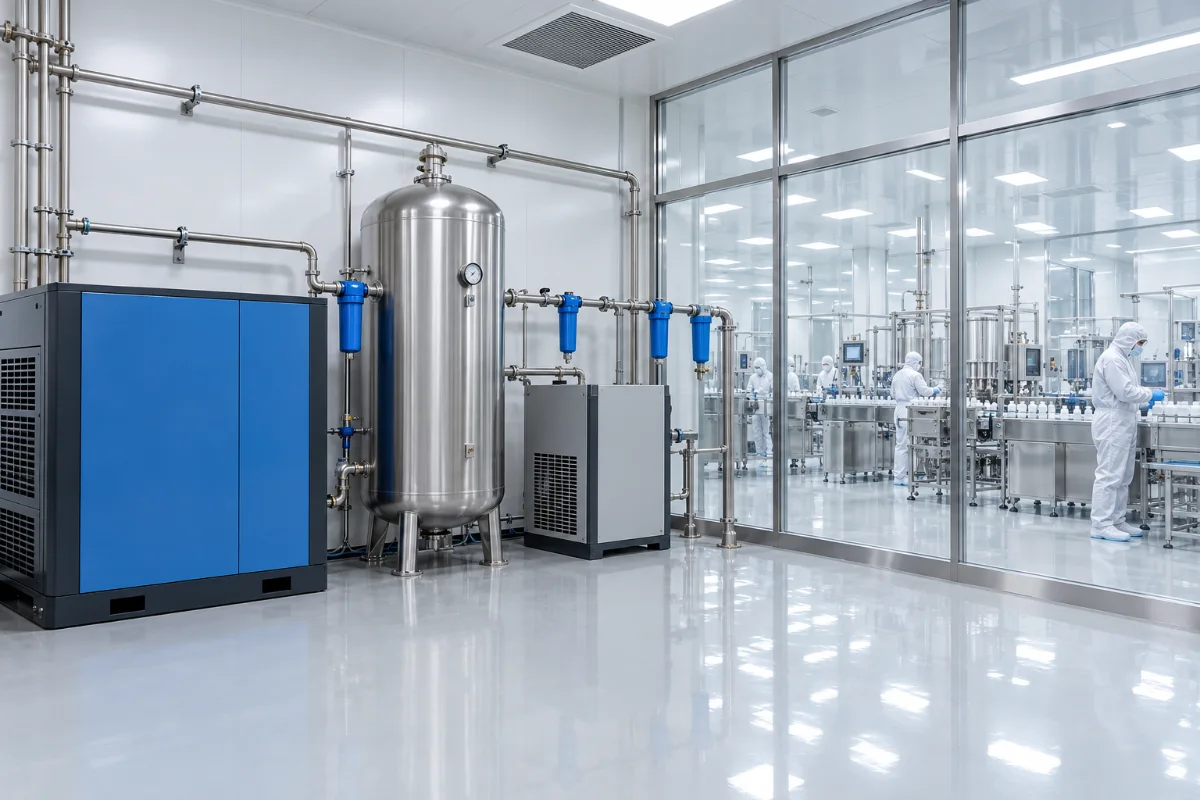
Energy Efficiency: Which Compressor Uses Less Electricity?
Neither compression method guarantees lower power consumption across every operating condition.
Oil injection helps with cooling and sealing, which can improve the compression process in suitable equipment. Oil-free designs may use advanced rotor geometry, multiple compression stages, intercooling, and optimized controls to reduce energy requirements.
These design differences cannot be converted into a reliable efficiency ranking without comparing actual models.
The correct question is how much electrical power each complete compressor package requires to deliver the specified airflow at the required pressure.
Compare Specific Power, Not Motor Horsepower
Motor horsepower identifies a nominal motor rating. It does not directly tell the buyer how efficiently the compressor produces usable air.
Specific power relates compressor package input power to the volume of air delivered. A commonly used comparison expresses the result as kilowatts per 100 cubic feet per minute.
Specific power (kW/100 cfm) = package input power (kW) ÷ delivered airflow (cfm) × 100.
Lower specific power generally indicates less input power for the same delivered airflow, provided the compared equipment operates at equivalent pressure and reference conditions.
The Compressed Air & Gas Institute (CAGI) recommends standardized performance data for meaningful equipment comparisons. Its verification program uses recognized test methods, including ISO 1217 for compressors, and reports package performance information that purchasers can compare.[2]
Buyers should request the following information:
Rated free air delivery at the specified operating pressure.
Total package electrical input power at the corresponding operating point.
Specific power or equivalent efficiency information.
Part-load power consumption where variable output is expected.
Applicable test method and stated inlet reference conditions.
Electrical consumption of relevant auxiliary equipment.
Total package input power deserves particular attention because motor-only figures can overlook other electrical loads associated with the compressor package.
I’d reject an energy comparison that places one compressor's capacity at a lower operating pressure against another compressor's capacity at a higher pressure without appropriate normalization.
Why Operating Pressure Changes the Result
Producing compressed air at a higher pressure generally requires more compression work.
If the production equipment needs 90 psig at the point of use, specifying a compressor solely around a nominal 125-psig operating point may result in unnecessary energy consumption.
The compressor discharge pressure must account for the actual minimum pressure needed downstream, normal filter and dryer pressure losses, piping losses, control differential, and operating margin.
That margin should be engineered rather than selected by habit.
Pressure losses also change as components become dirty or airflow increases. A properly designed monitoring system can identify developing restrictions before operators compensate by raising the compressor setpoint.
Variable-Speed vs. Fixed-Speed Control: A Separate Purchasing Decision
Oil-free versus oil-injected describes the compression method. Fixed-speed versus variable-speed describes how the compressor output is controlled.
These decisions should not be confused. Both lubrication categories can be available with fixed-speed or variable-speed arrangements, depending on manufacturer and model.
A fixed-speed screw compressor is often suitable when production demand is relatively stable. It may operate efficiently as a base-load machine when its output closely matches continuous consumption.
A variable-speed drive compressor adjusts motor speed within its permitted operating range, allowing airflow to respond more closely to changing demand.
This can reduce unnecessary unloaded operation and improve pressure control, but a variable-speed drive does not guarantee lower annual electricity consumption under every load profile.
When I’d Consider Variable-Speed Equipment
I’d prioritize variable-speed evaluation when several production lines operate independently, air demand changes substantially between shifts, or the existing equipment spends significant time unloaded.
The most useful evidence is a recorded demand profile showing airflow and pressure throughout representative production periods.
Variable-speed machines also have minimum operating-speed limits. Below the supported control range, the system may still require unloading, stopping, storage capacity, or coordinated operation with another compressor.
An oversized variable-speed compressor can therefore operate inefficiently despite having advanced controls.
For changing production demand, the AIRNOVEX variable-speed screw compressor range provides a starting point for reviewing available control configurations. The final decision should use model-specific part-load performance data.
When Fixed-Speed Equipment Still Makes Sense
A stable, continuous base load is a strong reason to evaluate a fixed-speed compressor.
In a multi-compressor installation, a practical arrangement may use a fixed-speed unit for base demand and a properly sized variable-speed unit to handle fluctuations.
Such a combination can avoid forcing a large compressor to operate inefficiently over a wide range of demand.
Correct sequencing and adequate storage are essential. Poorly coordinated compressors may operate against each other, repeatedly load and unload, or maintain unnecessarily high system pressure.
For facilities with relatively consistent air consumption, fixed-speed industrial screw compressors remain a relevant option to compare on purchase cost, measured package efficiency, and maintenance requirements.
Two-Stage Compression: Does It Change the Oil-Free Decision?
Two-stage compression is another design characteristic that should be evaluated independently of the oil-management method.
A two-stage compressor divides the required pressure increase between separate compression stages. Intercooling may be incorporated to reduce the air temperature before the second stage.
With appropriate pressure ratios and cooling, this arrangement can reduce compression work compared with an alternative configuration.
However, two-stage compression does not automatically mean that a compressor is oil-free.
Both oil-injected and oil-free screw compressor designs can use multiple compression stages. The terms describe different aspects of the equipment.
| Compressor Configuration | What the Design Means | Primary Evaluation Point |
|---|---|---|
| Single-stage oil-injected | One oil-injected compression stage. | Acquisition cost, efficiency at rated pressure, and oil-management requirements. |
| Two-stage oil-injected | Two compression stages using an oil-injected design. | Measured package efficiency, cooling arrangement, and operating cost. |
| Single-stage oil-free | One compression stage without injected lubricant. | Available pressure, air delivery, temperature control, and purity requirements. |
| Two-stage oil-free | Two oil-free compression stages, often with intercooling. | Complete-package efficiency, cooling requirements, and contamination control. |
For continuous-duty applications, I’d evaluate two-stage compression against a comparable single-stage machine at the same pressure and delivered flow.
The AIRNOVEX two-stage screw compressor configurations can be reviewed for applicable capacity, pressure, and drive options. Buyers should confirm the lubrication method of each proposed model rather than inferring it from the number of compression stages.
Initial Purchase Price vs. Total Cost of Ownership
The price difference between oil-free and oil-injected compressors is real, but a universal percentage premium would be misleading.
Equipment cost depends on capacity, pressure, rotor and bearing design, compression stages, cooling method, control system, electrical requirements, and the scope of the supplied package.
An oil-free compressor may require a larger initial investment. An oil-injected compressor may require additional downstream contamination-control equipment depending on the process specification.
Neither initial equipment price tells the full economic story.
Total cost of ownership should include the acquisition cost, electricity, scheduled maintenance, consumables, air treatment, service support, and the expected financial consequences of operational interruptions.
A Transparent Electricity Cost Comparison
The following calculation is an illustrative purchasing model, not published performance data for a specific compressor and not a customer operating result.
Assume two compressor packages are proposed for the same required airflow and discharge pressure. The example intentionally assigns different package power inputs to demonstrate how electricity affects the investment decision.
| Assumed Input or Calculated Result | Option A: Oil-Injected | Option B: Oil-Free |
|---|---|---|
| Required delivered airflow | 300 cfm | 300 cfm |
| Operating pressure | 100 psig | 100 psig |
| Assumed package input power | 70 kW | 77 kW |
| Annual operating hours | 6,000 hours | 6,000 hours |
| Assumed electricity price | $0.14/kWh | $0.14/kWh |
| Calculated annual electricity use | 420,000 kWh | 462,000 kWh |
| Calculated annual electricity cost | $58,800 | $64,680 |
| Calculated eight-year electricity cost | $470,400 | $517,440 |
Annual electricity cost = average package power × annual operating hours × electricity rate.
Under these assumptions, Option B uses $5,880 more electricity per year. Over eight years, the undiscounted difference is $47,040.
That figure does not establish that oil-free compressors normally consume more electricity. The assumed package power values are hypothetical. Actual equipment might show a smaller difference, no meaningful difference, or the opposite result.
It also excludes financing, demand charges, energy-price changes, part-load behavior, maintenance, and replacement costs.
The purchasing lesson is straightforward: relatively modest differences in package power can create substantial operating costs when compressors run for extended periods.
What If the Oil-Free Compressor Costs More to Operate?
A higher operating cost does not automatically make oil-free compression the wrong investment.
Suppose the production process could suffer material rejection, contamination-related cleaning, or extended downtime after an oil-related quality failure. Those consequences belong in the financial evaluation.
The difficulty is that contamination costs are highly application-specific. Assigning a generic annual failure cost or probability would make the comparison look precise without providing reliable evidence.
I’d recommend using documented production history, quality investigations, realistic recovery procedures, and site-specific financial assumptions instead.
A useful purchasing model is:
Annual ownership cost = electricity + maintenance + air treatment + expected contamination-related cost + other operating expenses.
Capital investment can then be evaluated separately or included in a discounted lifecycle cash-flow model.
The expected contamination-related cost should be based on defensible assumptions, not a supplier's unsupported claim that a compressor eliminates all process risk.
Do Not Ignore the Cost of Air Treatment
Both compressor types may require dryers, receivers, condensate management, and particle filtration.
An oil-injected installation may require additional coalescing and vapor-removal equipment to meet the specified purity level. Those components create purchase, replacement, monitoring, and pressure-drop costs.
An oil-free installation may reduce certain oil-removal requirements, but it still needs protection from moisture, particles, ambient hydrocarbons, and downstream contamination where applicable.
Dryer purge air, filter differential pressure, cooling utilities, and service labor should be included in any serious operating-cost comparison.
For contamination-sensitive production, treatment reliability may have greater business value than a small difference in routine filter expenditure.
Maintenance Requirements and Long-Term Reliability
Oil-free compressors are sometimes described as maintenance-free because they do not inject lubricant into the compression chamber. That description is incorrect.
Oil-free machines still contain rotating assemblies, bearings, seals, cooling components, control equipment, and electrical systems. Depending on the design, lubricated gears and bearings require scheduled servicing.
Oil-injected compressors have additional lubricant-management requirements, including oil condition, oil filters, separator elements, and the performance of the lubrication circuit.
The absence of an injected-oil circuit does not eliminate mechanical wear or guarantee a longer service life.
| Maintenance Item | Oil-Free System | Oil-Injected System |
|---|---|---|
| Inlet air filtration | Inspect and service according to contamination and pressure-drop conditions. | Inspect and service according to contamination and pressure-drop conditions. |
| Compression-chamber oil | No injected compressor oil in a dry-running compression chamber. | Monitor oil condition and replace lubricant according to approved requirements. |
| Oil separator element | Not required for separating injected oil from a dry-running airend. | Inspect, monitor, and replace according to equipment requirements. |
| Bearings and gears | Service as specified for the mechanical arrangement. | Service as specified for the mechanical arrangement. |
| Cooling system | Maintain coolers, airflow, fans, or cooling-water circuits. | Maintain coolers, airflow, fans, or cooling-water circuits. |
| Airend condition | Monitor performance, temperature, vibration, and mechanical condition. | Monitor performance, temperature, vibration, and mechanical condition. |
| Downstream treatment | Maintain dryers, filters, drains, and monitoring equipment. | Maintain dryers, filters, drains, and monitoring equipment. |
| Electrical controls | Inspect motor, drive, controller, and protective systems. | Inspect motor, drive, controller, and protective systems. |
What Actually Determines Maintenance Cost?
I’d rank maintenance predictability above claims about having fewer service items.
A compressor with inexpensive routine consumables may still be costly if major replacement parts are difficult to obtain. Conversely, an expensive specialized machine may be financially reasonable when it operates reliably in a high-value production process.
Maintenance planning should consider the documented service schedule, component accessibility, parts availability, required technician skills, and likely downtime associated with scheduled work.
Actual replacement intervals depend on the manufacturer, operating conditions, lubricant requirements, and condition-monitoring results. A universal interval should not be assigned to either technology.
Conditions That Shorten Equipment Life
Excessive ambient temperature, poor ventilation, contaminated intake air, unstable electrical supply, incorrect pressure settings, and neglected cooling systems can damage either type of compressor.
Repeated short cycling or operation outside an approved control range can also create unnecessary mechanical and electrical stress.
For dry-running oil-free equipment, rotor clearances and temperature control deserve particular attention because compression-chamber sealing does not rely on injected oil.
For oil-injected equipment, lubricant condition, oil-system temperature, and separator performance require consistent monitoring.
Both designs benefit from recorded operating data and maintenance decisions based on actual equipment condition.
Which Compressor Is Better for Different Industrial Applications?
The required air purity depends on the function of the compressed air, not merely the type of facility.
One manufacturing site may use compressed air for direct product contact, instrument control, and general pneumatic tools. Those applications can justify different air-quality specifications and sometimes different supply arrangements.
Food and Beverage Production
Oil-free compression deserves strong consideration where compressed air directly contacts food, ingredients, beverages, or product-contact packaging surfaces.
Lubricant contamination can create product-quality and process-control concerns. However, oil-free compression alone does not establish microbiological suitability or compliance with a facility's food-safety requirements.
The complete system may still require appropriate filtration, drying, hygienic design considerations, monitoring, and documented validation.
For non-contact pneumatic equipment operating separately from the product stream, an appropriately treated oil-injected system may remain a practical option.
Pharmaceutical and Sensitive Process Manufacturing
Some pharmaceutical and closely controlled manufacturing processes require carefully specified compressed-air purity.
Where air contacts a sensitive product or manufacturing environment, the evaluation should address particles, moisture, oil, and any additional contamination hazards identified by the process risk assessment.
I’d generally give oil-free compression a higher initial ranking when compressor lubricant introduces an unacceptable contamination pathway.
That recommendation does not replace formal process qualification. Testing, monitoring, equipment design, and the required quality documentation remain essential.
Electronics and Precision Manufacturing
Precision components can be sensitive to unwanted residue, particulates, and moisture.
Oil-free compression may be attractive when compressed air is used for direct blowing, component handling, or sensitive manufacturing operations.
However, cleanliness requirements vary considerably between applications. Some processes need additional particle filtration, very dry air, or controls for contaminants unrelated to compressor lubricant.
The required specifications should come from the actual product and process rather than a general industry label.
Automotive Assembly and Metalworking
Pneumatic tools, clamps, cylinders, and general assembly equipment often operate successfully with properly maintained oil-injected compressed-air systems.
However, surface preparation, precision cleaning, and selected finishing operations may require more stringent contamination control.
An oil-free compressor may be justified for a dedicated sensitive process, but replacing an entire plant-air system is not necessarily the most economical solution.
Separating critical applications from general utility air can provide a more targeted investment.
Textile Production
Textile manufacturing uses compressed air for pneumatic machinery, conveying, and selected high-consumption production equipment.
The significance of oil contamination depends on whether compressed air contacts fibers, fabric, or finished material.
For air-contact processes where lubricant residue could damage product quality, oil-free compression deserves evaluation. For auxiliary pneumatic functions, appropriately treated oil-injected equipment may provide sufficient air quality.
Stable pressure, accurate flow sizing, and energy efficiency are especially important where compressed-air demand is continuous.
Wastewater Treatment and Industrial Utilities
In wastewater facilities, the first distinction should be between low-pressure process aeration and higher-pressure utility or instrument air.
Large biological aeration systems commonly require substantial airflow at comparatively low pressure. A dedicated blower may be more appropriate than a conventional plant-air compressor for that duty.
Higher-pressure compressed air may be used for instrument controls, valve actuation, maintenance equipment, and selected process functions.
Oil-injected screw compressors can be suitable for many utility-air applications with appropriate air treatment. Oil-free compression may be considered where the process establishes a stricter lubricant-contamination requirement.
I would not specify an oil-free screw compressor simply because the application involves water treatment. The actual process pressure, air quality, and operating requirements should determine the technology.
Real Industrial Evidence: Why System Optimization Matters Before Replacement
Compressor replacement decisions can become unnecessarily expensive when the actual source of wasted air has not been identified.
Two documented industrial examples demonstrate why airflow measurement, leak detection, and production-based controls should be considered before comparing new compressor technologies.
2024 Case: Measuring Air Consumption at the Equipment Level
A published 2024 industrial energy-management case described how a manufacturing facility used airflow meters, data collection, and Grafana dashboards to understand compressed-air consumption during production and idle periods.
The facility combined monitoring with pneumatic component improvements, leak repairs, and programmable controller changes.
The reported results included more than 80% lower idle-state air consumption and 25% lower running-state air consumption for the equipment addressed in the project. The case also identified an expected annual energy-cost benefit of $60,000 after broader implementation; that amount was a projected figure rather than a verified annual cash result.[3]
The useful lesson is not that the facility should have purchased a particular compressor type. It is that measured demand revealed operating losses that equipment nameplates could not explain.
A compressor selected before those improvements could have been unnecessarily large.
2025 Case: Ultrasonic Measurement and Leak Reduction
A 2025 industrial efficiency recognition described an automotive manufacturing project using clamp-on ultrasonic flow meters to locate and quantify compressed-air leaks.
The documented project reported a 30% reduction in the compressed-air leakage rate and a 27% reduction in peak demand, supported by targeted leak repair and control of unnecessary compressed-air blowoffs.[4]
These are project-specific results, not expected savings percentages for other plants.
For a compressor purchasing decision, the implication is significant: correcting avoidable air demand can change the required compressor capacity, operating profile, and economics of both oil-free and oil-injected equipment.
I’d recommend documenting the demand after practical system improvements, then comparing replacement compressors against the corrected requirement.
How to Size an Oil-Free or Oil-Injected Compressor Correctly
Correct compressor sizing begins with the air actually needed by the connected equipment.
Nominal motor horsepower is not a substitute for airflow data. Neither is the size of an existing compressor, particularly if the installed system has been expanded, modified, or poorly maintained.
For a new installation, the engineer should identify normal and peak airflow requirements, actual simultaneous usage, minimum point-of-use pressure, daily operating pattern, and required air quality.
For a replacement installation, measured operating data can provide a more reliable starting point.
Step 1: Establish Normal and Peak Air Demand
List the individual compressed-air consumers and determine which operate simultaneously.
Airflow should be expressed using clearly defined reference conditions. CFM, SCFM, ACFM, and free air delivery may refer to different measurement bases and should not be treated as interchangeable without clarification.
A receiver tank can help manage short-duration demand fluctuations, but it does not replace sufficient compressor capacity for sustained consumption.
Where demand varies, record the duration and frequency of peaks rather than adding every equipment nameplate flow into one unrealistic continuous requirement.
Step 2: Confirm Required Operating Pressure
Identify the minimum pressure needed at the most demanding point of use.
Account for the pressure losses across dryers, filters, piping, valves, and other system components. These losses should be evaluated at the actual expected flow.
Excessive compressor discharge pressure increases operating costs, while insufficient pressure can cause production interruptions.
The correct setpoint balances equipment requirements, distribution losses, and pressure stability.
Step 3: Define the Air-Quality Specification
Specify the required particle, water, and oil purity classifications independently.
If a particular process requires Class 0 oil purity, state the agreed acceptance limit and the verification method instead of relying on the equipment being described as oil-free.
Also identify the measurement location. An air-quality target specified at the compressor outlet may not adequately protect a distant process connection.
Step 4: Evaluate Site Conditions
Ambient temperature, altitude, humidity, cooling-air movement, available cooling water, and the compressor-room layout affect equipment performance.
Electrical supply requirements must also be confirmed before ordering, including voltage, frequency, phase, and applicable protective arrangements.
A compressor that meets its catalog performance under reference conditions may require correction when installed under materially different conditions.
For critical processes, standby capacity and the ability to perform maintenance without interrupting production should be considered during system design.

What to Request From a Compressor Manufacturer Before Buying
A commercially attractive quotation is not sufficient unless the technical scope is comparable.
I’d recommend sending the same operating requirements to every shortlisted supplier and requiring each proposal to identify the exact equipment configuration and performance basis.
The purchasing package should make it possible to distinguish equipment performance from sales assumptions.
| Required Document or Detail | Why It Matters | Purchasing Check |
|---|---|---|
| Model-specific technical datasheet | Defines proposed capacity, pressure, power, and equipment configuration. | Confirm values correspond to the quoted model and operating pressure. |
| Airflow and package power data | Supports a meaningful energy comparison. | Request applicable test methods and reference conditions. |
| Compression design description | Clarifies oil injection, dry-running operation, and stage arrangement. | Verify the actual lubrication method and cooling design. |
| Air-quality documentation | Supports contaminant-control requirements. | Review test scope, applicable limits, and supporting reports. |
| Maintenance schedule | Supports service planning and cost evaluation. | Confirm consumables, service tasks, and major maintenance requirements. |
| Electrical and installation drawings | Establishes utility and space requirements. | Confirm voltage, frequency, connections, clearance, and cooling needs. |
| Air-treatment proposal | Defines the complete delivered-air solution. | Review dryer capacity, filtration, pressure drop, and dew point. |
| Warranty and parts support | Reduces uncertainty in long-term ownership. | Confirm exclusions, replacement parts, response procedures, and service responsibilities. |
| Inspection and acceptance requirements | Establishes how delivered equipment will be evaluated. | Agree on documentation, inspection scope, and acceptance criteria. |
How I’d Evaluate a Manufacturing Partner
For industrial compressor procurement, I’d place greater weight on traceable technical documentation and service capability than on unsupported claims of exceptional efficiency.
A capable supplier should be able to explain the proposed airend configuration, operating limits, electrical components, control method, cooling requirements, and routine maintenance needs.
For an oil-free proposal, the supplier should address how lubricated components are isolated from the air path and provide applicable air-quality evidence when a purity classification is claimed.
For an oil-injected proposal, the supplier should explain oil separation, expected air treatment, separator monitoring, and the maintenance conditions necessary to support the stated performance.
AIRNOVEX is one manufacturing and supply option for industrial rotary screw compressor projects. Its product range includes oil-free, fixed-speed, variable-speed, and two-stage configurations. Any final purchase decision should still depend on the exact model offered, documented performance, application requirements, and agreed commercial terms.
The same verification standard should apply to every supplier under consideration.
Common Buying Mistakes That Can Distort the Comparison
Several recurring specification errors make otherwise reasonable compressor comparisons unreliable.
Comparing nameplate horsepower instead of delivered airflow: Two compressors with similar motor ratings can have different capacities and package efficiencies.
Assuming oil-free means contaminant-free: Moisture, particles, intake hydrocarbons, and downstream contamination remain possible.
Treating Class 0 as a universal absolute-zero guarantee: The agreed contaminant limit and testing conditions must be documented.
Ignoring part-load operation: A strong full-load efficiency figure does not establish efficient performance across a changing demand profile.
Confusing two-stage compression with oil-free compression: Stage arrangement and lubrication method are independent design characteristics.
Excluding downstream treatment costs: Filters, dryers, pressure losses, replacement elements, and monitoring can change ownership economics.
Using an old compressor's capacity as the only sizing reference: Leaks, changes in production, and poor control may have distorted actual demand.
Accepting unsupported energy-saving claims: Savings depend on a defined baseline, actual operating hours, equipment performance, and control behavior.
My view is that specification quality has a greater influence on a successful purchase than the number of features included in a brochure.
A properly sized, well-maintained compressor with suitable air treatment is more valuable than a technically sophisticated machine installed without regard to the actual process.
Final Selection: When I’d Choose Each Compressor Type
For a contamination-sensitive process where compressor lubricant presents an unacceptable quality risk, I’d recommend evaluating oil-free compression first.
The higher initial cost may be justified by reducing an identified contamination source, simplifying part of the lubricant-control strategy, and supporting a more defensible process design.
That recommendation assumes the oil-free package can meet the required flow, pressure, reliability, air-quality verification, and operating-cost requirements.
For general plant air serving pneumatic tools, industrial controls, and equipment without unusually strict lubricant-contamination limits, I’d usually include oil-injected screw compressors on the shortlist.
The lower acquisition cost frequently makes them commercially attractive, provided the system includes the required separation, drying, filtration, and maintenance provisions.
For a facility with both sensitive and general-purpose air users, I’d also evaluate separate air networks or dedicated treatment branches instead of automatically applying one purity requirement to every outlet.
Where annual electricity consumption dominates the purchasing decision, the preferred compressor should be determined by measured or properly documented package efficiency at the required pressure and actual load profile.
The best compressor is the one that consistently delivers the required quantity and quality of air at an acceptable lifecycle cost, with a maintenance and risk profile the operation can support.
Frequently Asked Questions
1. Is an oil-free rotary screw compressor better than an oil-injected compressor?
Answer: An oil-free compressor is generally the stronger candidate when injected lubricant contamination presents an unacceptable process risk. An oil-injected compressor may be more economical for general industrial air with suitable downstream treatment. Neither technology is universally superior in electricity consumption or reliability. Compare air-quality requirements, package efficiency, maintenance obligations, and the financial consequences of contamination before selecting a model.
2. Can an oil-injected screw compressor deliver oil-free compressed air?
Answer: An oil-injected compressor can produce compressed air that meets specified low-oil-content requirements when suitable separation, filtration, vapor treatment, and verification are used. However, the compressor still introduces lubricant into the compression process, so its contamination-control approach differs from oil-free compression. Buyers should specify a measurable oil-purity target and verify performance at the required location rather than relying on a general description.
3. Does an oil-free compressor automatically meet ISO 8573-1 Class 0?
Answer: No. Oil-free describes the absence of injected lubricant in the compression chamber. ISO 8573-1 Class 0 describes an agreed contaminant limit more stringent than the corresponding Class 1 requirement. Ambient hydrocarbons and downstream contamination can still affect the final air supply. Request the relevant numerical limit, test method, sampling location, and supporting evidence before accepting a Class 0 claim.
4. Which compressor is more energy-efficient?
Answer: Efficiency depends on the specific compressor design, operating pressure, airflow, compression stages, motor, controls, and load profile. Compare total package input power and delivered airflow at equivalent conditions. For variable-speed equipment, examine part-load performance as well as full-load ratings. An oil-free design is not automatically more efficient, and an oil-injected design is not automatically less efficient.
5. Do oil-free screw compressors require less maintenance?
Answer: Oil-free machines avoid several maintenance tasks associated with injecting oil into the compression chamber, but they still require mechanical, cooling-system, intake-filter, and electrical maintenance. Bearings and gears may still use lubricant outside the air path. Maintenance cost depends on the exact design, operating conditions, service schedule, and spare-parts requirements. Request a model-specific maintenance plan before comparing ownership costs.
6. Is an oil-free compressor necessary for food or pharmaceutical manufacturing?
Answer: Not every compressed-air application within these facilities requires the same compressor technology. Oil-free compression deserves strong consideration for direct product-contact or other contamination-sensitive uses. General pneumatic utilities may be served by appropriately treated oil-injected systems if the facility's risk assessment and quality specifications allow it. Process-specific requirements, testing, and validation determine the final design.
7. Can I replace an oil-injected compressor with an oil-free compressor?
Answer: Yes, provided the replacement meets the required airflow, pressure, operating profile, electrical supply, and installation conditions. Review the existing receiver, dryers, filters, piping, condensate management, and control system before replacement. If the purpose is to improve air purity, evaluate residual contamination in the existing distribution network. Installing an oil-free compressor does not automatically remove oil deposits already present downstream.
8. What information is needed to request an accurate compressor quotation?
Answer: Provide required airflow with defined reference conditions, minimum point-of-use pressure, expected operating hours, normal and peak demand, electrical supply, cooling conditions, and the intended application. Include the required particle, water, and oil purity specifications, as well as any standby or monitoring requirements. Ask for model-specific package power, air delivery, maintenance documentation, and a clearly defined equipment scope.
Technical References and Industry Sources
The technical framework and documented case-study figures in this article are supported by the following sources. Illustrative purchasing calculations are identified separately and should not be interpreted as measured compressor performance.
International Organization for Standardization (ISO).ISO 8573-1:2010 — Compressed Air: Contaminants and Purity Classes.Published April 2010; confirmed in 2017. Applicable published edition as of 2026, with revision work underway.View the official ISO standard information.
Compressed Air & Gas Institute (CAGI).Performance Verification and Standardized Compressor Data Sheets.Industry guidance on independently verified compressor performance, ISO 1217 testing, specific power, and equipment comparisons. Accessed 2026.View CAGI performance verification guidance.
Better Buildings & Better Plants Initiative.3M: Energy Data Management System Improves Readiness for ISO 50001/SEP Certification.Published April 16, 2024. Documents compressed-air monitoring, pneumatic equipment improvements, reported consumption reductions, and projected energy-cost savings.Read the published industrial case study.
Better Buildings & Better Plants Initiative.2025 Better Practice Recognition — Industrial Compressed-Air Leak Reduction.Reports the use of ultrasonic flow measurement, targeted leak repair, and reductions in compressed-air leakage rate and peak demand.View the 2025 industrial recognition information.
Editorial Note and Disclaimer
This article presents an equipment-selection analysis from an industrial air compressor manufacturing and supply perspective. The recommendations reflect engineering principles, published technical standards, and documented industry examples rather than claimed personal operating records or independently verified tests of the equipment discussed.
Any illustrative cost calculations are based on explicitly stated assumptions and do not represent supplier quotations, guaranteed electricity consumption, maintenance expenditures, or customer results.
Actual equipment suitability depends on operating pressure, airflow, inlet conditions, installation environment, air-quality requirements, maintenance practices, and model-specific technical data. Compressor air-purity claims should be supported by appropriate testing and documentation.
For food-contact, pharmaceutical, medical, breathing-air, hazardous-process, or other regulated applications, qualified specialists should establish the applicable design requirements, contamination limits, verification procedures, and compliance obligations. Industrial compressed-air equipment should not be assumed suitable for breathing-air service without a system specifically designed and approved for that purpose.
Purchasing and engineering decisions should be confirmed against current manufacturer documentation, applicable standards, and the requirements of the actual installation.